
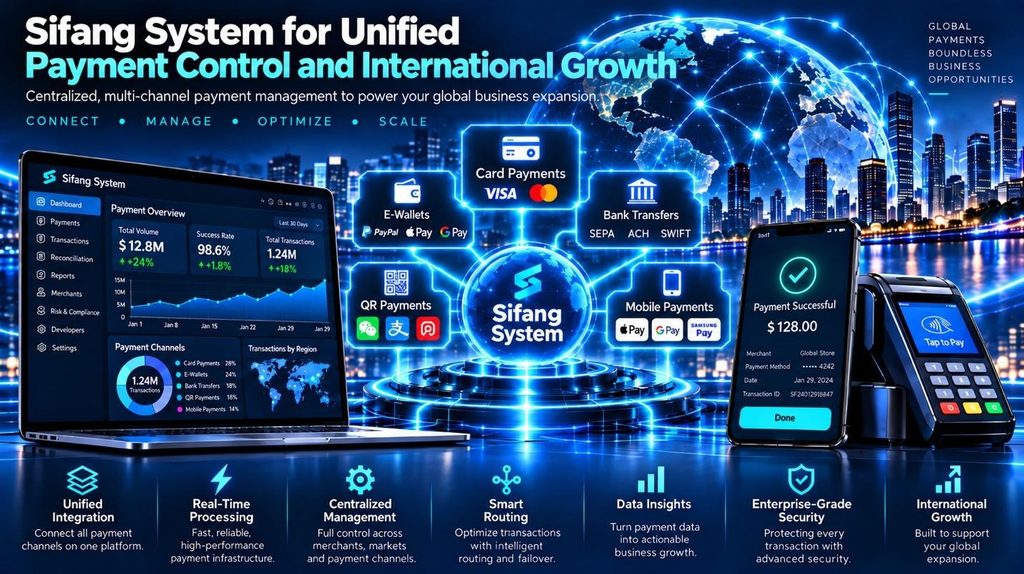
The 四方系统 provides a structured payment infrastructure for businesses that need to manage multiple payment channels, merchants, agents, collections, payouts, and settlement processes from one environment. Instead of operating different providers through disconnected workflows, businesses can use a centralized platform to organize payment activity more efficiently.
For companies working across several markets, the Sifang System can also support broader international payment operations while maintaining clearer control over transactions, routing, and account management.
A Unified Structure for Payment Operations
Managing a payment network can become complicated when several providers and merchant accounts are involved.
Different channels may have their own transaction limits, rates, settlement rules, and operating conditions. Without centralized management, operators may spend too much time moving between separate systems.
The Sifang System brings important payment functions together.
Administrators can manage merchants, agents, payment channels, transaction records, settlements, and operational settings through a more consistent structure. This can make daily management easier and provide a clearer overview of the entire payment environment.
Payment Aggregation Across Multiple Channels
One of the main purposes of the Sifang System is to simplify multi-channel payment integration.
Businesses can connect different payment providers and configure each one according to specific requirements. Individual channels can have their own rates, transaction limits, operating rules, and priority settings.
This allows a payment business to create a more flexible network.
Instead of depending on one provider for all transaction activity, multiple channels can work together inside the same infrastructure.
Better Routing for Transaction Flow
When several payment routes are available, it becomes important to control how transactions are distributed.
The Sifang System can support configurable routing strategies.
Operators can define channel priorities and decide how payment requests should move between available providers. Routing settings can be adjusted based on business needs, payment conditions, or channel availability.
If one route is unavailable, other connected channels may help maintain smoother transaction processing.
This creates a more adaptable payment operation and improves control over transaction flow.
Merchant Management with Flexible Settings
Different merchants often need different payment arrangements.
The Sifang System makes it possible to configure merchant accounts separately while keeping them within one central platform.
Administrators can assign available payment channels, establish transaction limits, manage payment rates, set permissions, and control settlement conditions.
This helps businesses support merchants with different operating requirements without creating a separate system for each account.
It also makes merchant activity easier to monitor.
Agent and Partner Administration
Payment networks may also include agents or business partners.
The Sifang System can organize these relationships through structured agent management.
Different permissions, commission arrangements, and merchant connections can be configured according to the platform’s business model.
This can reduce manual tracking and make it easier to understand how transactions and revenue are distributed across the wider network.
Collection and Payout Functions
The Sifang System can manage both payment collection and payout activity.
Incoming transactions can be monitored through centralized order records, while outgoing payments can be tracked according to their processing status.
Administrators can review transaction amounts, merchant information, channel details, and payment progress without relying on multiple separate dashboards.
Keeping these functions connected can improve operational visibility and help teams identify payment issues more quickly.
Settlement and Reconciliation Management
Settlement is a critical part of payment operations.
The Sifang System can help organize transaction and settlement records so businesses can compare expected results with completed payments.
Reconciliation tools can be used to review failed transactions, incomplete orders, delayed processing, or mismatched settlement information.
This creates a clearer financial workflow and makes it easier for payment teams to investigate differences when they appear.
Security and Risk Monitoring
Strong controls are essential for maintaining a reliable payment environment.
The Sifang System can support encrypted communication, transaction verification, account permissions, IP restrictions, transaction limits, and configurable risk-management rules.
Operators can monitor unusual transaction activity and review abnormal orders when necessary.
Different security controls can also be applied depending on merchant or channel requirements.
This helps businesses maintain stronger oversight of payment activity while reducing unnecessary operational exposure.
Flexible Source Code Deployment
Some payment businesses require more control over the platform they operate.
The Sifang System can support source-code deployment, allowing organizations to build and manage the environment according to their own operational needs.
A deployment may include merchant systems, agent management, databases, payment interfaces, transaction monitoring, callback settings, reporting, settlement, and reconciliation functions.
This flexibility can be useful for businesses that need customized workflows or expect their payment infrastructure to evolve over time.
Supporting Cross-Border Payment Operations
The Sifang System is also suitable for businesses working across multiple countries.
International payment operations often require different regional payment methods and provider connections.
The system can support payment-channel development across markets including the United States, India, Indonesia, Pakistan, Bangladesh, the Philippines, Vietnam, Brazil, Nigeria, Mexico, Ethiopia, Congo, Egypt, Iran, Turkey, Thailand, South Africa, and Kenya.
Regional payment channels can be added while the broader management structure remains centralized.
This can make cross-border expansion more manageable.
Operational Monitoring for Better Decisions
A payment system becomes more useful when operators can clearly see what is happening across the network.
The Sifang System provides visibility into transaction status, payment channels, merchant activity, settlements, payouts, and unusual orders.
Teams can use this information to review channel performance, investigate failed transactions, and adjust configurations when needed.
More consistent monitoring can also help businesses identify operational weaknesses before they affect a larger number of transactions.
Built for Expanding Payment Networks
As a payment business grows, the number of merchants, agents, payment channels, and supported markets can increase significantly.
The Sifang System provides a framework that can grow with those requirements.
New channels, merchant accounts, agent structures, and regional payment options can be introduced without rebuilding the entire payment environment.
This makes the platform suitable for businesses that want to maintain organized payment operations while continuing to expand.
Conclusion
The 四方系统 combines payment aggregation, merchant management, agent administration, transaction routing, collection, payouts, settlement, reconciliation, risk controls, and international payment support within one connected framework.
By centralizing these functions, businesses can manage complex payment activity with greater clarity and flexibility.
For organizations building a multi-channel or cross-border payment network, the Sifang System provides a scalable foundation for maintaining stronger operational control while supporting continued growth.
