
Introduction
Noise management is an important part of designing modern industrial equipment. Motors, pumps, compressors and moving machinery can generate sound that travels through enclosures and surrounding structures. In busy manufacturing environments, this noise may reach nearby workstations, offices or other operational areas, making it harder to maintain a comfortable and productive workplace.
Controlling the problem requires more than identifying a noisy machine. Engineers must understand how sound travels, which surfaces allow it to pass through and whether vibration contributes to the overall issue. Selecting suitable acoustic barrier materials can help address these challenges while allowing manufacturers to retain practical equipment layouts.
Understanding Sound Transmission in Industrial Settings
Sound travels through air and can also pass through solid materials. When machinery operates inside a metal enclosure, its sound energy can cause the panels to vibrate. Those panels may then radiate noise into the surrounding environment.
Openings, joints and service access points can create additional routes for sound to escape. Vibration transmitted through mounting brackets, frames or connected pipework can further complicate the situation.
This explains why covering a machine with an absorptive material does not always provide the required result. Absorption helps reduce sound reflections, while a barrier is intended to impede sound transmission through an assembly. Depending on the problem, a successful design may require both approaches.
Manufacturers should therefore assess the entire equipment structure rather than focusing on one surface in isolation.
How Acoustic Barriers Support Noise Control
Acoustic barriers are designed to improve sound insulation by introducing a material layer that resists the transmission of airborne noise. Their performance depends on factors such as mass, material composition, thickness, mounting arrangement and the construction of the surrounding panel.
Flexible barriers are especially useful when a rigid board would be difficult to install. They can be incorporated into selected equipment housings, metal panels and other assemblies where space or surface geometry creates limitations.
Acoustafoam supplies acoustic barrier products in different material constructions for industrial and commercial applications. Its range includes polymeric acoustic membranes and bitumen-based barriers with protective facings.
These products can be considered for applications where reducing transmission through a panel is more important than simply absorbing reflections inside a room.
The correct choice depends on the frequency range, available space, operating environment and required acoustic improvement. A technical assessment is helpful when the installation has demanding performance targets.
Choosing a Barrier for Lightweight Metal Panels
Lightweight panels are common in machinery housings, vehicle bodies and manufactured appliances. They reduce overall weight and can simplify assembly, but some panel constructions may vibrate when exposed to sound from nearby equipment.
This vibration can contribute to unwanted noise. A suitable barrier applied in close contact with the panel can add mass and help improve the sound insulation of the overall construction.
Acoustafoam identifies its C03 and C09 polymeric barriers as options for improving the sound insulation of existing metal, wood and plastic panels. The product information describes these materials as low-density vinyl acoustic membranes loaded with naturally occurring materials.
The membranes are intended for applications where panel construction and resonance behaviour need to be considered. Their suitability should be assessed against the actual panel, mounting method and expected acoustic conditions.
For equipment designers, the main advantage of considering a flexible barrier is the ability to add an acoustic layer without necessarily replacing the entire panel assembly.
Understanding the Different Barrier Constructions
Not every barrier product is intended for exactly the same application. Material construction and surface treatment can affect installation, durability and suitability for the working environment.
Polymeric acoustic barriers are one option where a flexible membrane is needed to improve the sound insulation of existing panels. They can be considered for lightweight constructions where panel behaviour contributes to noise transmission.
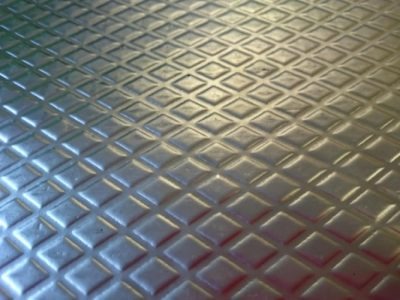
Acoustafoam also offers bitumen-based barriers covered with PE foil. Its C022 and C023 products are described as diamond-embossed, black PE-faced barriers with self-adhesive backing. The facing helps contain the bitumen-based material and provides a surface that can support bonding to suitable substrates.
For applications involving heat exposure, the C024 aluminium-covered acoustic barrier is another option listed by Acoustafoam. Its construction incorporates a dense mixture of bitumen, polymers and mineral fillers, with an aluminium foil surface.
These product differences matter because the best solution depends on the intended use. Buyers should check the technical data for each option rather than assuming that all barriers have identical acoustic or environmental properties.
Why Vibration Control Should Be Part of the Assessment
Noise transmission and vibration are closely related, but they are not interchangeable problems. A machine may produce airborne sound while also transferring mechanical vibration into its supporting structure.
If vibration reaches a large metal panel, that panel may act as another source of noise. In such situations, the design may need a combination of barrier material, damping treatment and appropriate mechanical isolation.
Acoustafoam describes its acoustic barrier range as having vibration-dampening applications and identifies anti-vibration uses among its product benefits.
However, the required treatment depends on the source and transmission path. A barrier may improve the acoustic performance of a panel, but it should not automatically be considered a replacement for vibration isolators, resilient mounts or other mechanical measures.
Where vibration is significant, the equipment should be assessed to identify how energy travels through the assembly. Addressing the source and the transmission route can help avoid relying on a material that does not match the underlying problem.
Applying Acoustic Barriers to Complex Equipment Shapes
Industrial equipment often includes curved covers, angled surfaces and irregularly shaped components. A rigid barrier may be difficult to fit to these designs without extensive modification.
Flexible acoustic barriers can offer more practical installation options where the surface is slightly curved or wavy. Acoustafoam states that its barriers can be supplied in sheets or converted into die-cut and water-jet-cut shapes according to customer specifications.
Custom conversion can be particularly useful when a manufacturer needs multiple parts with consistent dimensions. A defined component shape can simplify production assembly and reduce the amount of manual trimming required on site.
To support accurate manufacturing, purchasers should provide measurements, drawings and details of any cut-outs or fixing points. They should also explain whether the component will be fitted to a flat panel, a curved surface or a composite structure.
The final design must allow the barrier to sit correctly against the intended substrate and remain compatible with the surrounding assembly.
Combining Barriers with Acoustic Foam
Some industrial noise problems require both sound insulation and sound absorption. A barrier can help limit transmission through an assembly, while a suitable foam layer can reduce reflections within an enclosure.
Acoustafoam offers the option to combine acoustic barriers with acoustic foams to create bespoke laminates. This approach allows designers to consider different acoustic functions within a single construction.
For example, an equipment enclosure may require a barrier layer to help reduce sound passing through the outer panel, alongside an absorptive layer facing the internal noise source. The arrangement must be designed around the intended performance, available depth and fixing method.
Layer order, facing characteristics and installation details can influence the result. Simply adding several materials does not guarantee an improvement, so the finished construction should be assessed against the actual noise-control objective.
For demanding applications, acoustic testing can help establish whether the proposed combination meets the design requirements.
Industrial Applications Beyond Factory Machinery
Acoustic barriers are used in a range of barrier products where sound transmission, panel vibration or installation constraints need attention.
Potential applications identified by Acoustafoam include:
- Automotive components and vehicle interiors.
- Earth-moving and agricultural machinery.
- White goods and domestic appliances.
- Lift cabins and metal furniture.
- Steel sinks and tubs.
- Pipe insulation assemblies.
- Industrial machinery and equipment housings.
Each application has its own operating conditions. A barrier used in an appliance may have different requirements from one installed in a construction vehicle or marine environment.
Temperature, exposure to moisture or oils, available space and fixing arrangements should all be considered before the material is selected.
Planning Procurement and Installation
A clear technical brief helps manufacturers obtain more relevant product recommendations. Instead of requesting a barrier based only on its dimensions, buyers should describe the panel construction and the noise issue they want to address.
Useful details include the substrate material, panel thickness, surface shape, operating environment, available installation depth and whether the component needs adhesive backing or another fixing arrangement.
Where possible, the supplier should also receive information about the equipment’s operating conditions and any required performance targets.
Installation quality matters as well. Poor contact with the substrate, unsuitable adhesive or gaps in the treated area may reduce the benefit of the chosen material. The selected barrier should be installed in accordance with the supplier’s guidance and the requirements of the finished assembly.
A planned approach can help manufacturers integrate acoustic treatment without unnecessary changes to their equipment design.
Conclusion
Industrial noise control requires a clear understanding of how sound travels through air, panels and supporting structures. Acoustic barriers can help improve sound insulation and address panel-related noise when the material and installation are selected for the application.
Flexible polymeric membranes, faced bitumen barriers and combined foam-and-barrier constructions offer different possibilities for equipment manufacturers. Their suitability depends on the panel design, operating conditions and desired acoustic outcome.
For projects involving machinery housings, vehicle components, appliances or other manufactured products, exploring Acoustafoam’s acoustic barriers can help identify suitable material formats and custom-conversion options. A well-defined specification provides a stronger starting point for selecting a practical noise-control solution.
