
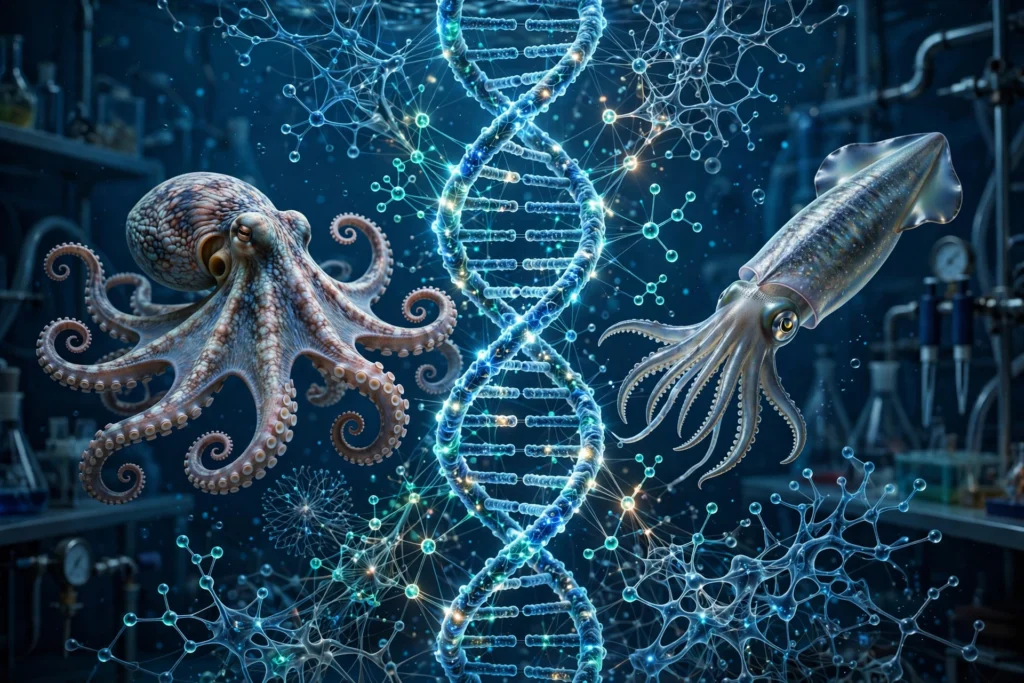
Octopuses can open jars, navigate mazes, recognise individual people and change colour and texture in a fraction of a second. Squid and cuttlefish show similarly striking abilities. For decades, biologists have asked how animals so distant from vertebrates evolved such complex brains. New research from the University of Vienna suggests part of the answer lies not only in which genes cephalopods carry, but in how their DNA is folded in three dimensions inside the cell.
The study, reported by the University of Vienna, examined genome architecture in cephalopods and found that the physical organisation of their DNA may have helped enable the evolution of sophisticated nervous systems. Discussion of the work on r/science has drawn wide attention, reflecting public fascination with octopus intelligence.
More Than a List of Genes
A genome is often described as a book of instructions, but the analogy is incomplete. DNA does not sit in a cell as a straight, tidy line of text. It loops, folds and clusters, bringing distant genes and their regulatory switches into physical contact. Those contacts matter. When a regulatory element touches a gene, it can increase or reduce that gene’s activity, shaping when, where and how strongly it is used during development.
In the brain, timing is everything. Neurons must form in the right places, connect in precise patterns and respond flexibly to experience. Small changes in gene regulation during development can therefore produce large differences in the final nervous system, even when the underlying gene set looks broadly similar to that of less complex relatives.
That is why 3D genome structure is increasingly seen as a missing layer in evolutionary biology. Two species can share many genes yet build very different bodies and brains if those genes are organised and controlled differently.
What the Vienna Team Found
According to the University of Vienna summary, the researchers analysed how DNA is packaged and arranged in cephalopod genomes and compared those patterns with other animals. Their work points to distinctive structural features that may have supported the expansion and specialisation of neural functions in octopuses, squid and their relatives.
Cephalopods are unusual in several ways. They evolved large, complex nervous systems independently of vertebrates, they edit RNA extensively in neural tissues, and many species show learning, memory and flexible behaviour rarely seen in other invertebrates. A genome architecture that allows sophisticated regulation could help coordinate those traits, linking developmental programmes to the demands of a highly active, predatory lifestyle.
The findings do not suggest a single “intelligence gene.” Instead, they support a systems view: brain complexity emerges from networks of genes, regulatory contacts and developmental processes working together over evolutionary time.
An Independent Route to a Complex Brain
Cephalopods last shared a common ancestor with humans hundreds of millions of years ago. Their complex brains are therefore a striking example of convergent evolution — nature reaching a similar outcome, a large and capable nervous system, through a different evolutionary path.
That independence makes them especially valuable for science. If similar principles of genome organisation appear in both vertebrate and cephalopod brain evolution, those principles may be fundamental. If cephalopods found different solutions, studying them could reveal alternative ways to build intelligence that researchers would miss by studying only mammals and birds.
It also raises careful questions about how these animals experience the world. Greater understanding of cephalopod cognition has already influenced welfare discussions in some countries, and deeper genetic insight will add context, even if it does not by itself answer ethical questions.
What Comes Next
Genome maps are a starting point, not a final explanation. Researchers will now need to test which specific 3D contacts affect neural development, compare more cephalopod species, and connect structural changes to behaviour and learning in living animals. Advances in imaging, gene editing and single-cell analysis should make those tests increasingly possible.
For now, the Vienna research offers a compelling shift in perspective. To understand how an octopus became so clever, scientists may need to look beyond the sequence of its DNA and study its shape — the folds and loops that help turn genetic information into one of the most remarkable brains in the animal kingdom.
For more reading from our site, see our latest blog coverage and other science and insights features.
