
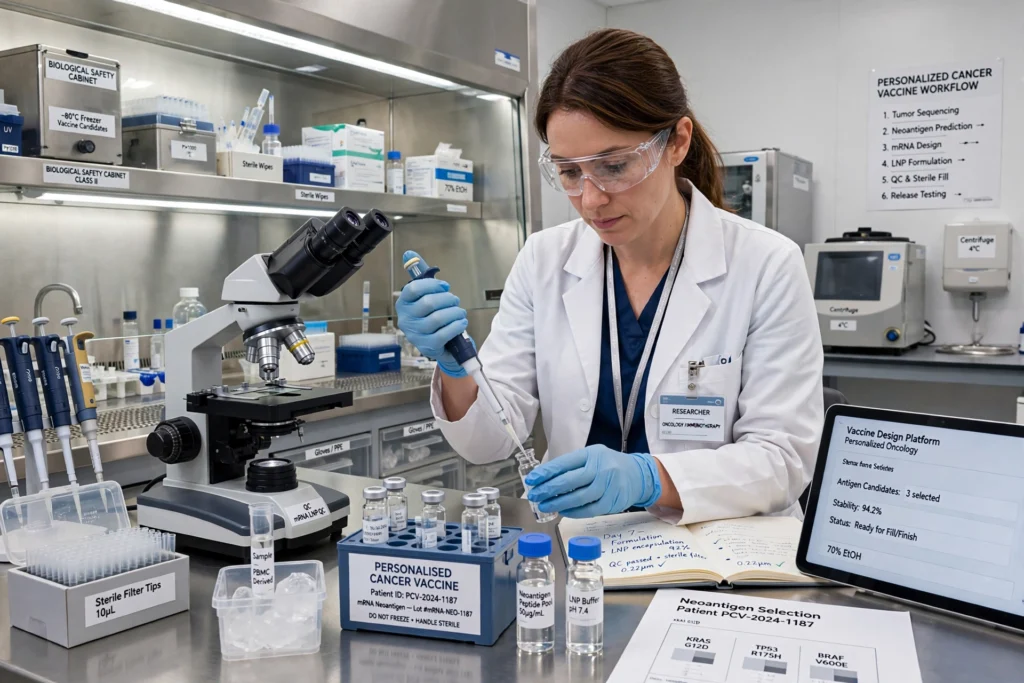
A personalised cancer vaccine called NeoVax has been tested with the immunotherapy drug nivolumab in women with platinum-sensitive recurrent ovarian cancer, in a phase 1 trial published in Nature Medicine. The important word in that sentence is early. This was a small first step designed mainly to ask whether such a vaccine could be made for individual patients, given safely, and whether it stirred the immune system. It was not designed to prove that the treatment extends life, and this article will not pretend otherwise. Readers interested in our health coverage can also see our recent background reading on the site.
Built from the mutations in one person’s tumour
NeoVax belongs to a class of treatments called personalised neoantigen vaccines. Every tumour collects mutations that healthy cells do not carry. Some of those mutations create abnormal protein fragments, called neoantigens, that can flag the cancer as foreign to the immune system. A NeoVax vaccine is manufactured for one patient at a time using that patient’s own tumour mutations as the blueprint. The goal is to teach immune cells what to look for, rather than giving every patient an identical product off a shelf. Background on this approach is available from the National Cancer Institute.
Why nivolumab was given alongside it
The vaccine was combined with nivolumab, a PD-1 immune checkpoint inhibitor. Tumours can exploit checkpoint pathways to quieten the immune cells sent against them. A PD-1 inhibitor releases part of that brake. In principle, the pairing is logical: the vaccine tries to raise an army of T cells that recognise tumour-specific targets, while nivolumab tries to stop those cells being switched off too quickly when they arrive. That reasoning is exactly why combinations like this are studied carefully, step by step, rather than rushed into routine care.
What a phase 1 trial is for
Phase 1 studies sit at the start of clinical testing. Their central questions are feasibility and safety. Can the product be manufactured to schedule for real patients whose cancer has returned? Can it be delivered in the clinic without unacceptable side effects? Researchers also collect early biological signals, in this case evidence of immune responses. The full report appears in Nature Medicine, and anyone reading coverage of it should keep that phase 1 framing firmly in mind throughout.
What the researchers found
On the questions the trial was built to answer, the results were encouraging in a narrow, specific sense. The personalised vaccines could be manufactured and administered to patients. Safety was judged acceptable for this early setting, which is a meaningful hurdle for a bespoke product with a long production chain. The team also saw immune responses, including T-cell activity directed at the targeted neoantigens. Those are the signals a phase 1 trial hopes to detect. They show the concept can work in the body, not that it has yet improved patient outcomes.
What this does not show
It does not show a cure, and it does not prove the vaccine shrinks tumours or helps women live longer. The group was small, there was no comparison arm designed to isolate benefit, and recurrent ovarian cancer is a disease where responses need to be judged over longer follow-up in larger groups. Honest reporting matters here because hope is powerful and early headlines can easily run ahead of evidence. The researchers themselves present this as feasibility work, and that is the level at which it should be understood and discussed.
The road from feasibility to proof
For NeoVax and similar vaccines, the next steps are larger studies with more patients, clear comparisons, and endpoints that measure clinical benefit directly. Manufacturing also has to become faster and more reliable if personalised treatment is ever to be practical at scale, since each dose begins with sequencing one person’s tumour. None of that diminishes the value of a careful phase 1 result. Medicine advances by answering one question properly at a time, and this trial answered its first questions: it can be made, it can be given, and the immune system responds.
