
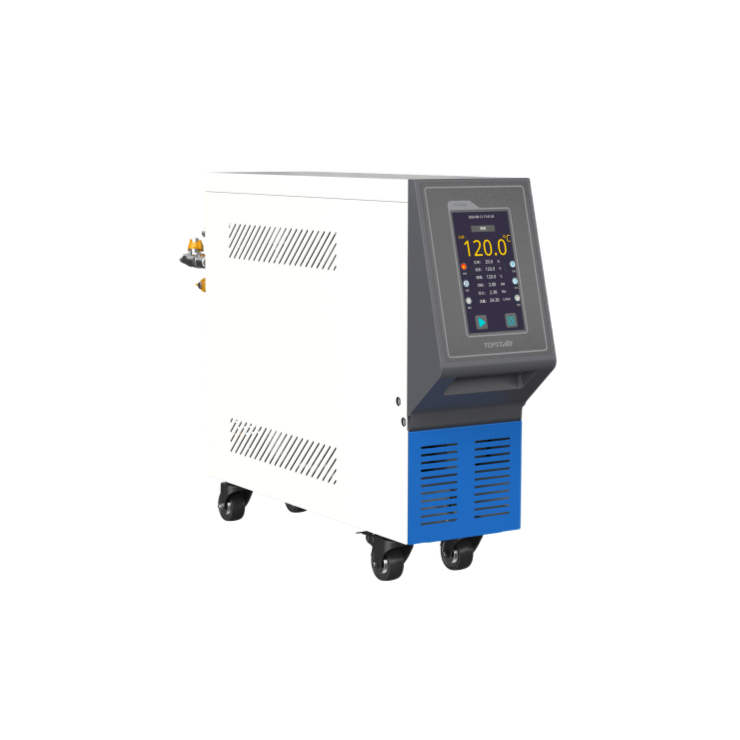
Every injection moulding engineer understands that precise temperature control determines whether a mould produces stable, high-quality parts or unstable, defective products. Even slight fluctuations in mould cavity temperature can affect the flow properties, cooling efficiency, dimensional accuracy, and surface finish of the plastic. Therefore, the mould temperature controller plays a crucial role in modern plastics manufacturing systems. However, not all temperature control technologies achieve the same performance. Many plants still rely on traditional mould temperature controllers that use basic control logic to regulate heating and cooling. While these systems may still function, they often struggle to maintain stable temperatures during dynamic moulding cycles.
Mould Temperature Controller in Injection Moulding Stability
Mould temperature controllers regulate the temperature of an injection mould by circulating heated or cooled fluid through channels within the mould. This process ensures that the mould maintains a constant temperature throughout the production cycle. Temperature control directly impacts several key aspects of plastic moulding, including melt flow characteristics, cooling rate and cycle time, product surface quality, and dimensional stability. When mould temperature controllers fail to maintain stable temperatures, defects such as warpage, shrinkage marks, flash, or inconsistent gloss can occur. Traditional temperature control systems typically employ simple feedback mechanisms.
These systems measure mould temperature and adjust heating or cooling output accordingly. While effective in basic applications, their response is often too slow to keep up with the rapid temperature changes during the injection moulding cycle. In contrast, advanced PID-based mould temperature controllers continuously analyse temperature trends and adjust control parameters in real time. This predictive capability significantly improves temperature stability. Understanding these fundamental control principles is crucial before comparing the performance differences between traditional and intelligent systems.
Mould Temperature Controller Control Logic: Traditional Algorithms vs PID Algorithms
The main difference between traditional and intelligent mould temperature controller lies in the control algorithm used to regulate temperature. Traditional systems typically employ on/off control or basic proportional control. In this configuration, the controller starts heating when the temperature is below the setpoint and stops heating when the target temperature is reached. While simple, this approach leads to temperature fluctuations. The system repeatedly overshoots and undershoots the target temperature, leading to temperature fluctuations that can affect mould stability.
Intelligent PID mould temperature controller operates differently. PID stands for Proportional, Integral, and Derivative. These three control elements enable the controller to predict and correct temperature deviations, preventing them from becoming significant. For example, the proportional component responds to current temperature errors, the integral component eliminates long-term deviations, and the derivative component predicts future changes based on temperature trends. Therefore, the PID mould temperature controller provides smoother, more stable temperature regulation throughout the moulding cycle.
Stability Testing Apparatus and Methods
To evaluate performance differences, engineers conducted controlled stability tests on two identical injection moulding machines equipped with different mould temperature controllers. The test environment included the same plastic material, mould structure, and injection moulding parameters. One system used a conventional mould temperature controller, while the other used an intelligent PID mould temperature controller. During the tests, engineers monitored mould temperature fluctuations, heating response time, temperature recovery after injection cycles, and product quality consistency. The purpose of this comparison was to determine the effectiveness of each mould temperature controller type in maintaining mould temperature stability under real-world production conditions.
Mould Temperature Controller Temperature Stability Test Results
A conventional mould temperature controller maintains mould temperatures within a ±3–5°C fluctuation range during continuous operation. While this range is acceptable for some applications, it can pose challenges for high-precision moulding processes. In contrast, intelligent PID mould temperature controllers maintain temperature stability within a narrower range of ±0.5–1°C. This improvement stems from the controller’s ability to predict temperature changes and dynamically adjust heating output. The stability advantage of PID mould temperature controllers directly improves process consistency and reduces the risk of product defects.
Impact of Mould Temperature Controllers on Product Quality
Temperature stability directly affects the quality of injection-moulded parts. During stability testing, engineers also evaluated product consistency between the two systems. With conventional mould temperature controllers, slight differences in surface gloss and shrinkage were occasionally observed in moulded parts. These inconsistencies are related to temperature fluctuations during the moulding cycle.
However, parts produced using PID mould temperature controllers exhibited significantly improved uniformity. Surface finish remained consistent, and dimensional accuracy improved across production batches. This stability is particularly important for high-precision industries such as automotive parts, medical devices, electronic housings, and optical plastic components. For these applications, advanced mould temperature controllers help manufacturers maintain stringent quality standards.
Future Trends in Intelligent Injection Moulding
With ongoing advances in injection moulding technology, the role of advanced mould temperature controllers is expanding. Modern systems are increasingly integrating with smart manufacturing platforms, enabling engineers to monitor temperature data and adjust settings remotely via digital interfaces.
Some intelligent PID mould temperature controllers now include features such as real-time process monitoring, adaptive learning algorithms, IoT connectivity, and automatic fault detection. These technologies enable more precise thermal management while reducing the need for human intervention. Looking ahead, integrating intelligent control algorithms into smart factories will make advanc
