
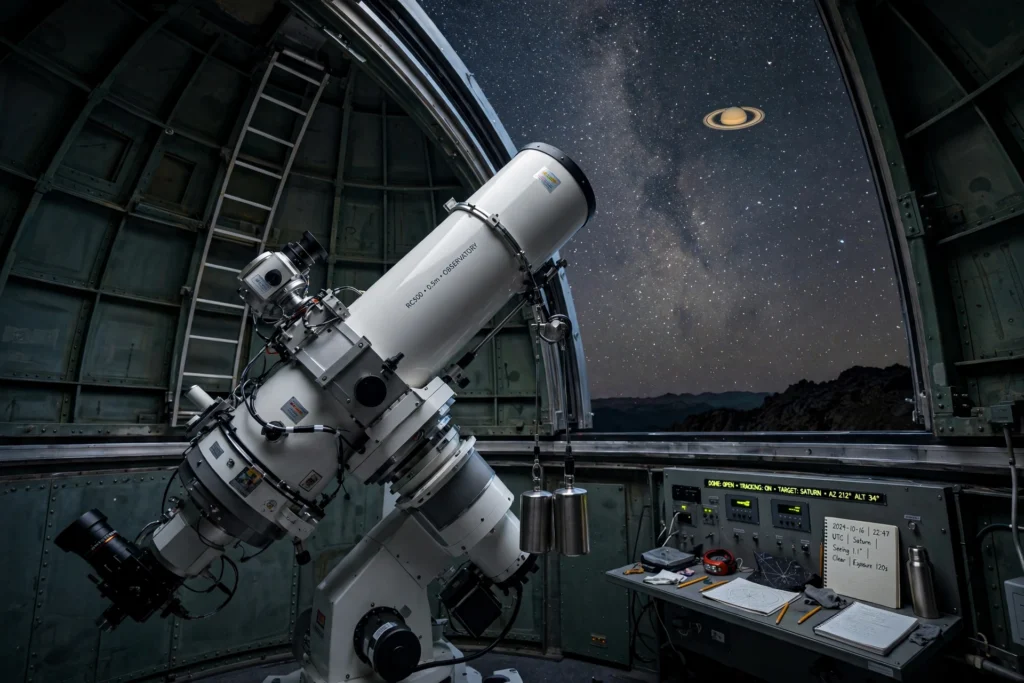
Saturn has pulled far ahead of every other planet in the moon stakes. Astronomers have confirmed 128 additional moons orbiting the ringed world, a recognition that lifts its official total from 146 to 274. That is more moons than all the other planets in the solar system combined, and it redraws what a single planetary family can look like. For readers following our wider coverage, including our look at how digital worlds keep expanding, this is a reminder that the real solar system is still expanding in our catalogues too.
How the announcement changes the count
The new figure did not come from a single night of discovery. These moons were tracked over several years before they could be counted with confidence, and they have now been recognised by the International Astronomical Union, the body that formalises such records. Recognition matters because a faint speck near Saturn is not automatically a moon. Researchers must follow its path, show that it keeps circling the planet, and rule out background stars and passing asteroids before the object earns a place on the list.
The telescope on a Hawaiian mountain
The survey behind the confirmations used the Canada-France-Hawaii Telescope, known as CFHT, high on Mauna Kea in Hawaii. Details of the instrument and its observing programmes are published by the Canada-France-Hawaii Telescope itself. From that dry, high site, astronomers gathered deep images of the space around Saturn again and again. The team included researchers from the University of British Columbia, among them Dr Edward Ashton, whose group has spent years patiently mapping the faint population that surrounds the giant planet.
Shift and stack: finding what one image hides
Most of the new moons are far too faint to stand out in an ordinary exposure. The team therefore used a technique called shift and stack. Many images are taken in sequence, then shifted in software so that each frame follows the expected motion of a Saturn moon, and finally stacked together. Light from a real moon lands in the same place every time and builds into a visible signal, while background stars smear and random noise averages away. It is slow, careful work, and it explains why confirmations arrive in a large batch rather than one by one.
Tiny, tilted and often travelling backwards
Do not picture 128 new versions of Titan. The newcomers are irregular moons, typically only a few kilometres across. They circle Saturn at great distances, on orbits that are strongly tilted compared with the planet’s equator and its orderly inner moons. Many travel retrograde, moving opposite to Saturn’s rotation. Those odd paths are clues to their origin. Regular moons probably formed alongside the planet from the same disc of material. Irregular moons, by contrast, look like visitors that were captured later by Saturn’s gravity and held ever since.
Shards left behind by ancient collisions
Researchers suspect that many of these small bodies are not original captured worlds at all. They may be fragments, pieces of larger captured moons that were smashed apart in collisions long ago. Groups of the new moons share similar orbits, which is exactly what you would expect if one parent body broke into several pieces that then drifted along comparable paths. Each cluster is therefore a small archive of violence in the outer solar system, preserving evidence of impacts that happened long before any telescope existed to record them.
Why astronomers care about such small worlds
A moon only a few kilometres wide will never host a lander, yet the population as a whole answers big questions. Counting these bodies tells scientists how much material moved around the young solar system, how often giant planets captured passing objects, and how collisions ground those objects down over time. The total of 274 will probably not stand forever, either. Better instruments and longer surveys may find still fainter members of the family. For now, Saturn’s lead is emphatic, and the ringed planet has become the clearest example of how rich a single world can become.
