
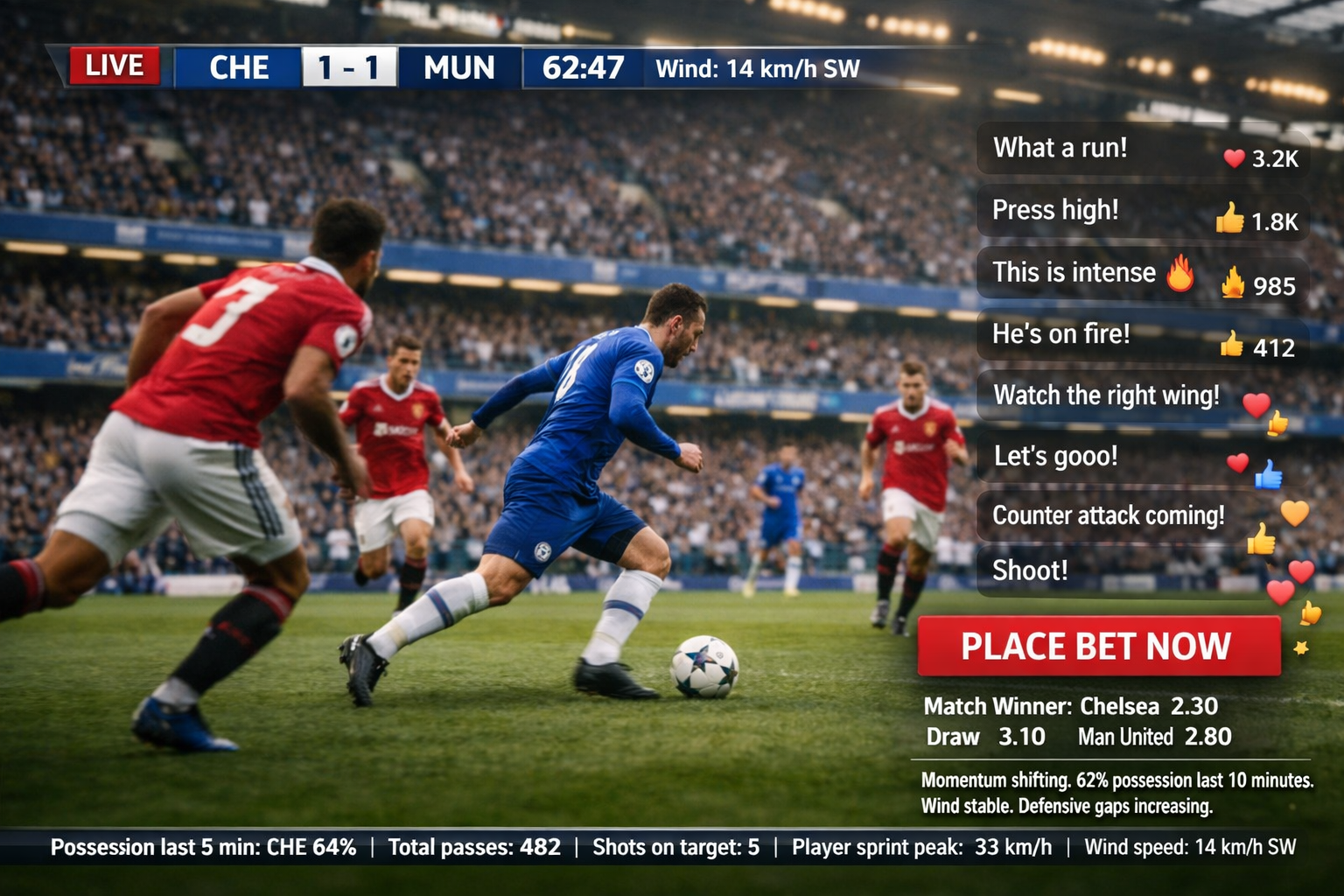
Live sports media has shifted from traditional one-way television broadcasting toward interactive digital ecosystems where high-definition video streams run concurrently with dynamic statistical feeds. Modern audiences expect real-time delivery of match metrics, ball-by-ball commentary, and contextual analytics without experiencing delay relative to the visual broadcast. Delivering this multi-layered experience requires media platforms to coordinate cloud infrastructure, edge computing nodes, and persistent data connections capable of servicing millions of simultaneous requests during peak sporting events.
Building an architecture capable of supporting this level of interaction involves solving fundamental challenges in network latency, data serialization, and client-side rendering. When video frames and telemetry updates originate from separate data sources, maintaining tight synchronization is critical to preventing spoilers, where text updates arrive before the corresponding video action occurs on screen. Resolving these operational bottlenecks requires systematic planning across API gateway design, protocol selection, and front-end state management.
Synchronizing Real-Time Data Feeds with Live Broadcast Streams
Integrating third-party statistical feeds into live video infrastructure presents distinct engineering challenges, primarily centered on timing alignment and load distribution. When platforms distribute live sports commentary alongside dynamic event updates, a latency mismatch between video frames and statistical payloads can cause significant disruption to the user experience. Engineering teams address this discrepancy by pairing low-latency streaming formats, such as Low-Latency HLS (LL-HLS), with lightweight bidirectional transport protocols including WebSockets and Server-Sent Events (SSE).
Managing high-concurrency traffic during major tournament matches requires resilient caching strategies and distributed API gateways. Modern sports platforms providing match feeds alongside tamasha live betting odds utilize edge computing nodes to process rapid metric adjustments close to end users. When a critical event occurs on the pitch, serverless microservices parse incoming telemetry from sports data providers, transform the payload into compressed JSON format, and push updates across client connections within milliseconds. This continuous data delivery keeps live scoreboards, match probabilities, and player statistics aligned with the video timeline.
Client-side application architecture must also handle high-frequency data ingest without causing UI frame drops. Operating on a single browser thread means that unoptimized Document Object Model (DOM) manipulations can easily lead to interface stutters during fast-paced play. Developers mitigate this by batching incoming WebSocket messages into memory buffers and scheduling UI re-renders using browser animation frames. This decoupling of network packet arrival from DOM update loops maintains smooth 60-frame-per-second interface performance even during rapid scoring sequences.
Technical Architecture for Ultra-Low Latency Video Delivery
Achieving broadcast-level latency over public internet infrastructure requires replacing traditional HTTP Live Streaming setups with modern streaming protocols optimized for sub-second delivery. Standard HLS introduces chunk buffers ranging between six and fifteen seconds, which creates a noticeable lag when compared to live data feeds or broadcast television. Transitioning to Low-Latency HLS (LL-HLS) or WebRTC reduces chunk durations into sub-second partial segments, enabling video players to process data fragments as soon as they are generated by the encoder.
Content delivery networks (CDNs) play a vital role in preserving stream stability under varying network conditions. By deploying origin shield servers and configuring regional edge caches, streaming platforms reduce origin server strain during traffic surges caused by key match moments. Additionally, adaptive bitrate (ABR) switching algorithms must be tuned specifically for low-latency profiles, ensuring that player clients drop video resolution rather than buffering when bandwidth fluctuates unexpectedly.
| Protocol | Latency Range | Scalability | Primary Use Case |
|---|---|---|---|
| WebRTC | Sub-second (< 500ms) | Moderate | Ultra-fast interactive sessions and peer-to-peer feeds |
| LL-HLS | 1.0 – 3.0 seconds | Very High | Large-scale live sports broadcasting with data sync |
| Standard HLS / DASH | 6.0 – 15.0 seconds | High | Asynchronous video-on-demand and legacy broadcasts |
Evaluating these protocols involves balancing operational costs against user latency requirements. While WebRTC offers near-instantaneous transmission, its connection establishment overhead makes scaling to millions of concurrent viewers significantly more expensive than HTTP-based segment delivery. LL-HLS strikes a balance by leveraging existing CDN caching architectures while keeping end-to-end latency low enough to match real-time statistical overlays.
User Experience Patterns for High-Density Sports Interfaces
Designing interfaces for live sports platforms requires balancing information density with visual clarity. Viewers frequently access streams on mobile devices with constrained screen real estate, making modular layout management essential. Interfaces typically prioritize the primary video player while placing supplementary components—such as live commentary, detailed match statistics, and interactive widgets—into collapsible panels or tabbed navigation elements.
Maintaining state consistency across multiple UI components requires centralized data management patterns. State containers receive parsed WebSocket events and propagate changes to specific visual components using reactive data bindings. When a player scores or a key milestone is reached, visual indicators highlight updated statistics briefly before fading back to a neutral state. This subtle visual cueing directs user attention to fresh data without cluttering the screen or overwhelming the viewer.
Cross-device compatibility demands comprehensive testing across diverse hardware profiles and network connections. Low-tier mobile devices often struggle with decoding high-bitrate video streams while simultaneously running complex JavaScript animation loops. Technical teams address this by implementing progressive enhancement strategies, automatically disabling heavy client-side computations or lowering frame rates on resource-constrained devices to prioritize uninterrupted video playback.
Resilience Strategies During High-Traffic Sporting Events
System stability during unpredictable traffic spikes depends on graceful degradation mechanisms built directly into platform infrastructure. Major tournament matches can drive sudden traffic multiplier spikes within seconds when millions of users tune in simultaneously. If primary data pipelines experience unexpected throttling or failure, fallback routines must immediately step in to prevent platform outages.
Implementing secondary polling endpoints provides a crucial backup when primary WebSocket connections drop under extreme load. If an edge proxy detects socket disconnection rates exceeding baseline thresholds, client applications automatically switch to periodic HTTP GET polling for critical data attributes like scores and match timers. This controlled reduction in update frequency protects core database infrastructure from cascading failures while ensuring users retain access to core match information.
Operational monitoring for live media platforms relies on synthetic user testing and real-time telemetry analytics. Telemetry tools track client-side metrics such as buffer ratio, start delay, bit-rate switching frequency, and API response latency. By establishing automated threshold alerts, operations teams can re-route traffic across alternative CDN providers or scale cloud instances before performance degradation impacts end users.
Engineering Resilient Ecosystems for Next-Generation Live Media
Delivering high-performance digital sports experiences requires alignment between video encoding, low-latency distribution networks, and real-time data ingestion pipelines. As viewer expectations evolve, platforms must maintain low latency while scaling infrastructure to support unpredictable concurrency demands. By combining protocols like LL-HLS with modular UI architectures and resilient fallback mechanisms, digital media engineering teams can deliver stable, responsive, and data-rich environments across all target platforms.
