
I started this hands-on test by evaluating SpaceProxy for geo-redirect testing as the network or infrastructure layer for this specific workflow. Affiliate links often pass through several systems before a visitor reaches the merchant: tracking domains, geo routing, campaign parameters, mobile redirects, and localized landing pages. A broken step can send traffic to the wrong country page or strip a parameter that attribution depends on. I tested SpaceProxy as a controlled geo layer for checking affiliate links and regional redirect logic from different markets, with attention to fixed IPv4/IPv6 endpoints, the provider’s diagnostic tools, and a repeatable browser workflow.
This is a QA use case, not an attempt to falsify clicks or commissions. I focused on opening authorized test links, checking the final destination, recording redirect chains, and confirming whether a page matched the intended market. A proxy cannot tell you whether an affiliate network credited a conversion correctly; it can help you reproduce the network location from which a redirect decision is made.
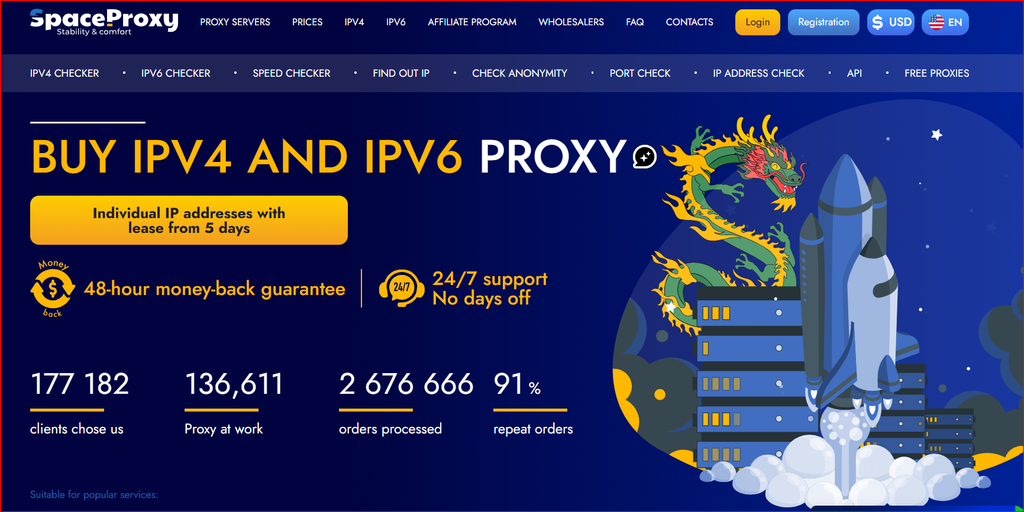
SpaceProxy homepage screenshot used during this September 2026 review.
How I Tested Redirect Behavior
I created test links for several hypothetical campaigns and recorded the expected merchant domain, country, language, currency, and final path. For each market I connected through one labeled endpoint, verified the visible IP, opened the link in a clean browser profile, and recorded the redirect chain. A simple HAR file or browser network log is useful because it shows every 301, 302, and tracking hop rather than only the final page.
I repeated the same link through the same endpoint after clearing cookies, then compared the result with a second market. If a destination changed unexpectedly, I could tell whether the difference was tied to geography, a cookie, or a link parameter. That is much more useful than randomly switching locations until a page looks right.
Why Fixed IPv4 Helps Affiliate QA
Individual IPv4 is my preferred option when a team needs to reproduce a redirect several times during a debugging session. A fixed endpoint makes it easier to compare results before and after a tracking rule is changed. Shared IPv4 is fine for lower-stakes public checks, but I would avoid mixing endpoint types within one documented bug report.
The important point is consistency. A marketing team should be able to hand a developer a test case that includes the exact URL, proxy market, browser state, and observed final destination. That turns an anecdotal ‘the link goes somewhere strange’ complaint into an actionable technical report.
Using IPv6 as a Separate Test Case
Affiliate infrastructure can involve old redirectors, third-party scripts, and merchant sites that do not all support IPv6 equally. I would therefore test IPv6 deliberately rather than substitute it silently for IPv4. If an IPv6 session reaches a different route or fails at one hop, that is useful information for the affiliate or merchant team.
Where the whole path supports IPv6, it can provide a low-cost extra compatibility check. I would preserve the network family in the log so the team knows whether a bug is geography-specific or protocol-family-specific.
Diagnostic Tools and API Planning
SpaceProxy exposes tools such as IP checks, anonymity checks, port checks, and speed checks on its site. I used those conceptually as preflight steps: verify the endpoint first, then test the affiliate link. That sequence prevents wasted debugging when the browser is simply not using the intended proxy.
For repeated campaigns I would automate only the boring validation pieces: endpoint verification, URL opening, redirect-chain capture, and final-domain comparison. I would not automate clicks in a way that simulates customers or interferes with affiliate reporting. The goal is QA, not traffic generation.
Pricing and Test Budget
Short leases are well suited to launch periods. A team can rent an endpoint for a few days, test the campaign in the required countries, and keep it active while fixes are deployed. Longer terms are more economical for always-on affiliate programs or recurring regional QA.
I would buy one reliable endpoint per important market first. If the same campaign must be tested across many countries, build a documented matrix and expand gradually. A smaller set of clearly labeled proxies is easier to audit than a large list that nobody can tie back to a test case.
| Proxy type | Typical current price | Rental term | Use case |
|---|---|---|---|
| Shared IPv4 | low-cost, varies by location | 5-360 days | Basic redirect checks |
| Individual IPv4 | varies by country and term | 5-360 days | Repeatable affiliate QA |
| IPv6 | lower-cost where supported | 5-360 days | IPv6 compatibility testing |
| API / tools | included site tools / account features | account dependent | Operational checks and automation |
Pricing snapshot: September 2026. Exact pricing, inventory, and location availability can change; verify current checkout information before purchase.
What I Liked
I liked the combination of fixed proxy products and simple diagnostic tools. Affiliate QA benefits from being able to confirm the network condition before testing the link itself. The English interface also makes the workflow easy to document for an international marketing team.
The range of lease lengths is another positive. Campaigns often have defined launch windows, so being able to align proxy rental with the QA period can reduce unnecessary spend.
Before finalizing the workflow, I rechecked the current offer on the SpaceProxy English website so the plan details matched the provider’s English-language website.
What I Would Improve
I would like an official affiliate-QA guide showing browser setup, redirect-chain logging, and examples of validating final domains without generating artificial traffic. More visibility into location inventory before purchase would also help campaign teams plan multi-country launches.
A simple exportable list of assigned proxies with labels and expiry dates would be useful for agencies. Operational mistakes often come from using the wrong endpoint rather than from the proxy technology itself.
My Test Notes
SpaceProxy is a practical fit when the task is to reproduce geo-dependent redirect behavior in a controlled way. The service is not an attribution platform, but it can supply the country-specific network identity needed to test whether links route as intended.
My preferred process is verify endpoint, open link in a clean profile, capture redirect chain, record final page, then repeat after changes using the same endpoint. That gives marketers and developers evidence they can act on without confusing QA with traffic generation.
FAQ
Can SpaceProxy be used to test affiliate redirects?
Yes, for authorized QA of links, landing pages and geo-routing rules. It should not be used to generate artificial affiliate traffic.
Why use a fixed proxy?
A fixed endpoint makes the redirect test reproducible across repeated checks and after rule changes.
Should IPv6 be tested separately?
Yes. Some redirect chains or merchant sites may behave differently over IPv6.
What should I log?
At minimum: test URL, market, proxy label, timestamp, redirect chain, final destination and browser state.
Conclusion
After working through the setup, pricing and limitations, my view is that SpaceProxy affiliate testing workflow is worth considering when the project matches the use case above and the team is prepared to test the exact region, tool or workload before scaling. I would start small, document the configuration, and expand only after the workflow produces consistent results. The service should be treated as one layer of a responsible technical process, not as a shortcut around platform rules, security controls, or sound operations.
