
I started this hands-on test by evaluating ProxyStores for regional availability checks as the network or infrastructure layer for this specific workflow. A website can be healthy from the operator’s office and still fail in another country because of CDN routing, DNS issues, regional blocking, bad geolocation rules, or third-party dependencies. I tested ProxyStores as a fixed-proxy layer for regional availability checks: not synthetic performance benchmarking, but controlled confirmation that a public page loads, redirects correctly, and serves the expected content from selected markets.
The key was repeatability. I wanted one labeled endpoint per country, a simple checklist, and enough stability to retest after an incident. I focused on individual and shared IPv4, IPv6, lease duration, and how the service fits with browser-based checks and lightweight scripted monitoring.
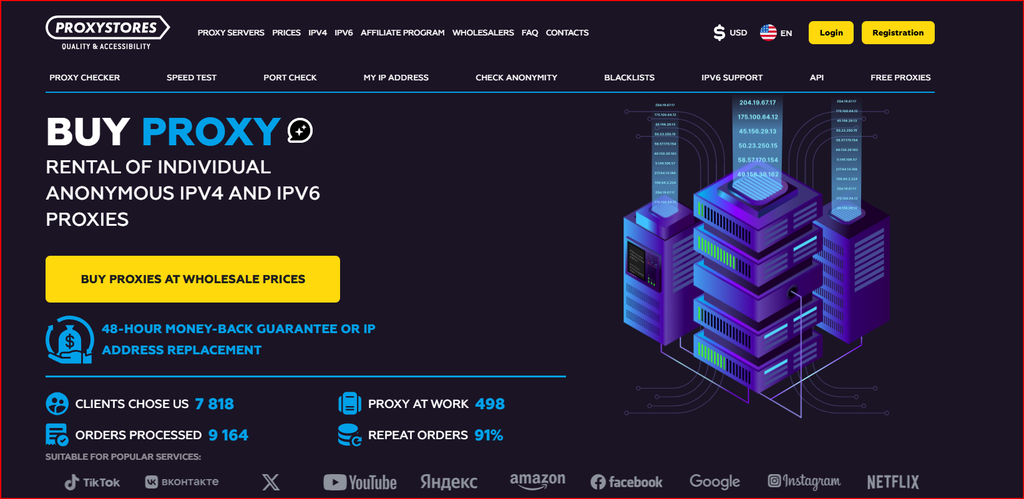
ProxyStores homepage screenshot used during this September 2026 review.
How I Tested Regional Availability
I defined a small set of public URLs: homepage, login page, checkout entry page, status endpoint, and one static asset. For each target country I connected through a fixed endpoint and recorded DNS resolution, HTTP status, final URL, visible page title, and whether the main asset loaded. I avoided aggressive polling; this was a diagnostic workflow designed to confirm a reported regional issue.
When a page failed, I compared the same URL from a second region and from the normal connection. That three-way comparison is valuable because it separates a truly global outage from a route or geo-specific problem. For incident response, screenshots and timestamps are useful evidence to share with a CDN, DNS, or hosting provider.
Individual vs Shared IPv4
For incident diagnosis I prefer individual IPv4 because the endpoint is easier to keep stable across several hours of testing. Shared IPv4 is adequate for periodic public-page checks when exclusivity is less important. I would not use a shared endpoint as the only source of truth for a high-severity incident because its history is outside my control.
That said, the proxy is only one observation point. A real monitoring strategy should include independent probes and server-side telemetry. The value here is the ability to reproduce what a visitor in a target country may encounter, not to replace infrastructure monitoring.
IPv6 as an Availability Dimension
Many organizations monitor IPv4 thoroughly and discover IPv6 problems only after users report them. ProxyStores’ IPv6 option can be used as a separate availability check where the target supports IPv6. I would verify DNS AAAA records and then compare the result with the IPv4 path.
If IPv6 fails while IPv4 works, the issue may be routing, firewall, CDN configuration, or the application itself. Keeping the two test types separate makes the incident easier to diagnose and prevents a working IPv4 path from hiding an IPv6 outage.
A Simple Monitoring Design
For lightweight recurring checks I would assign one endpoint to one market and run at a modest interval. The script should record status code, response time, redirect destination, and a small content marker. If the check fails twice, alert a human who can open the same URL in a browser using the same proxy label.
I would avoid treating response time through a proxy as a precise benchmark of end-user latency. The proxy path adds its own network characteristics. The better use is comparative: did the page load, did it reach the correct origin or CDN, and is the failure reproducible in one region but not another?
Pricing and Lease Strategy
The five-day and 30-day terms are useful for incident investigations, launches, and temporary regional checks. For always-on monitoring, longer terms reduce administrative churn because the endpoint remains attached to the same market for months. I would choose individual IPv4 for the most important regions and use shared or IPv6 endpoints for supplementary checks.
Before buying many addresses, define the markets that actually matter to the business. A company with customers in five countries gets more value from five documented regional probes than from dozens of unlabeled proxies.
| Proxy type | 5 days | 30 days | 90 days | 360 days |
|---|---|---|---|---|
| IPv4 Shared | $0.67 | $0.99 | $2.97 | $11.88 |
| Individual IPv4 (1-20) | $0.96 | $1.77 | $5.31 | $21.24 |
| IPv6 /32 (1-99) | $0.10 | $0.51 | $1.53 | $6.12 |
| MTProto (1-20) | $0.96 | $1.77 | $5.31 | $21.24 |
Pricing snapshot: September 2026. Exact pricing, inventory, and location availability can change; verify current checkout information before purchase.
What I Liked
I liked the clear fixed-proxy catalogue and the ability to match lease length to the monitoring need. The low entry price makes it practical to add a few external geographic observation points without building a large monitoring platform.
The website’s checking tools are also useful during incident response because the first step should always be verifying that the test endpoint itself is working before escalating a suspected site outage.
Before finalizing the workflow, I rechecked the current offer on the ProxyStores English website so the plan details matched the provider’s English-language website.
What I Would Improve
I would like availability-monitoring examples using curl, Python requests, and Playwright, including how to log redirect chains and content markers. A simple dashboard showing assigned IP, country, expiry, and recent replacement history would also help teams manage long-lived monitoring endpoints.
I would also emphasize in the documentation that proxy response time should not be marketed as a direct measurement of customer experience. It is an observation path, not a complete real-user performance metric.
My Test Notes
ProxyStores works best here as a regional diagnostic layer. It gives the operations team a repeatable country-specific point from which to confirm whether a page is reachable and serving the expected content. That can shorten the time between a customer report and a useful technical finding.
I would combine it with server telemetry, DNS monitoring, CDN logs, and at least one independent monitoring provider. The proxy adds context; it should not become the only monitoring system. In a real incident I would also preserve the exact failing URL, timestamp, resolver result, traceroute or route notes when available, and whether the failure affected HTML, API calls, or static assets. That extra context makes escalation to a hosting or CDN provider faster and helps prevent the team from treating every regional complaint as the same type of outage.
FAQ
Can ProxyStores be used for uptime checks?
Yes for lightweight regional availability checks, provided request frequency is reasonable. It should complement, not replace, infrastructure monitoring.
Which proxy type is best?
For critical markets I prefer individual IPv4 because the endpoint is exclusive and easier to keep consistent.
Can I monitor IPv6 separately?
Yes. That is a useful way to detect issues hidden by an IPv4-only monitoring setup.
Is proxy latency the same as user latency?
No. The proxy path adds its own network characteristics, so use it primarily for availability and comparative diagnostics.
Conclusion
After working through the setup, pricing and limitations, my view is that ProxyStores availability monitoring workflow is worth considering when the project matches the use case above and the team is prepared to test the exact region, tool or workload before scaling. I would start small, document the configuration, and expand only after the workflow produces consistent results. The service should be treated as one layer of a responsible technical process, not as a shortcut around platform rules, security controls, or sound operations.
