
Damascus knives are admired for their beautiful flowing patterns, exceptional craftsmanship, and outstanding cutting performance. However, their growing popularity has also led to a surge in counterfeit products that imitate the appearance of genuine Damascus steel without offering the same quality or durability.
The good news is that you don’t need to be a knife expert to identify a fake. With a few simple checks, you can often spot a counterfeit Damascus knife in under 30 seconds and avoid wasting your money on a poor-quality blade.
Why Fake Damascus Knives Are Everywhere
Authentic Damascus steel is created by forge-welding multiple layers of steel together before repeatedly folding and shaping them into a blade. This labour-intensive process produces the distinctive flowing patterns that make Damascus knives so desirable.
Unfortunately, because genuine Damascus requires skill, premium materials, and time, counterfeit manufacturers often take shortcuts by laser-etching patterns onto ordinary steel or chemically printing decorative designs that only resemble real Damascus.
1. Examine the Pattern Carefully
The fastest way to identify fake Damascus is to study the blade’s pattern.
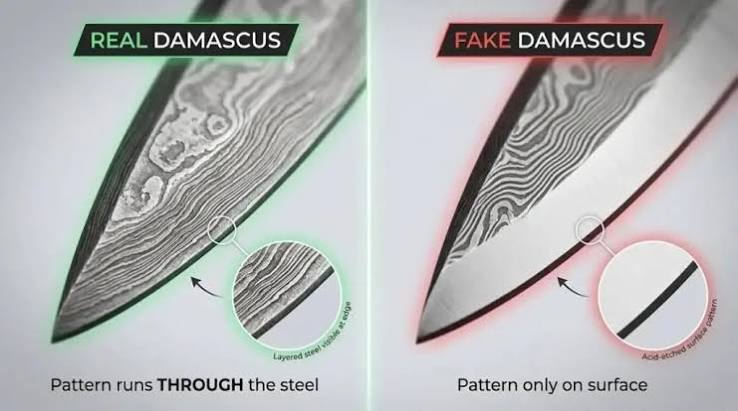
Real Damascus steel features natural waves, swirls, and flowing lines that vary across the blade. Since the pattern is created by layered steel, no two knives are exactly alike.
A genuine Damascus blade usually has:
- Natural-looking flowing lines
- Slight irregularities throughout the pattern
- Unique waves rather than identical repeats
- Visible layers extending toward the cutting edge
Fake Damascus often displays:
- Perfectly repeated patterns
- Uniform designs that look machine-made
- Printed or laser-etched graphics
- Decorative lines that appear too consistent
If the pattern looks identical from one end of the blade to the other, it’s worth investigating further.
2. Check the Spine
One of the quickest authenticity tests is to inspect the spine of the knife.
On genuine Damascus steel, the layered construction extends through the entire blade, meaning the pattern should also be visible on the spine.
If the sides display dramatic patterns but the spine looks completely plain, the blade may simply have an etched surface rather than genuine layered steel.
This inspection only takes a few seconds but can reveal a lot about the knife’s construction.
3. Inspect the Cutting Edge
Real Damascus steel extends all the way to the edge.
Look closely where the bevel meets the sharpened edge. On authentic Damascus knives, you’ll often notice the layered pattern continuing toward the cutting edge.
With fake Damascus knives, the decorative pattern frequently disappears near the edge, revealing ordinary steel underneath.
4. Feel the Blade Surface
Carefully run your finger across the blade.
Because different steel layers react differently during acid etching, genuine Damascus often has a subtle texture that can be felt under your fingertips.
Laser-etched or printed patterns usually feel perfectly smooth because the design sits only on the surface.
Although texture alone isn’t enough to confirm authenticity, it provides another useful clue.
5. Look for Pattern Continuity
The Damascus pattern should flow naturally around the entire blade.
Check:
- The spine
- The heel
- The tip
- The bevel
The pattern should continue consistently from multiple angles rather than stopping abruptly.
Artificial patterns often end suddenly or change direction unnaturally.
6. Consider the Price
Authentic Damascus knives require skilled craftsmanship and premium materials, making them more expensive than ordinary factory-produced knives.
If someone advertises a handmade Damascus knife at an unusually low price, it should raise questions.
Producing genuine Damascus involves:
- High-quality steel
- Forge welding
- Heat treatment
- Precision grinding
- Hand finishing
These processes simply cannot be replicated at bargain-basement prices.
7. Ask About the Steel
Reliable knife makers are transparent about the materials they use.
A reputable seller should be able to tell you:
- Which steels were used
- The approximate layer count
- Blade hardness
- Heat treatment process
- Country of manufacture
Vague descriptions like “premium Damascus” or “professional steel” without technical information should be viewed with caution.
8. Research the Manufacturer
Before buying, spend a few minutes researching the maker.
Look for:
- Genuine customer reviews
- Warranty information
- Real product photography
- Company history
- Detailed product specifications
Established knife makers are far more likely to provide authentic Damascus products backed by quality guarantees.
9. Beware of Perfect Patterns
Ironically, the most beautiful-looking Damascus pattern isn’t always genuine.
Authentic Damascus develops naturally during forging, creating subtle imperfections and unique variations.
Counterfeit blades often feature perfectly symmetrical, machine-generated designs repeated across every knife.
If it looks too perfect, it’s worth taking a closer look.
The 30-Second Damascus Authenticity Test
Before purchasing any Damascus knife, ask yourself these five questions:
- Is the pattern visible on the spine?
- Does the pattern continue toward the cutting edge?
- Does the design look naturally varied?
- Can the seller explain exactly which steels were used?
- Is the price realistic for handmade craftsmanship?
If several answers are “no,” there’s a strong chance the knife isn’t genuine Damascus steel.
Common Myths About Damascus Steel
Every Patterned Knife Is Damascus
Not true. Many manufacturers simply laser-etch decorative patterns onto ordinary steel.
More Layers Always Mean Better Quality
The number of layers alone doesn’t determine performance. Heat treatment, blade geometry, steel selection, and craftsmanship have a much greater impact.
Damascus Never Rusts
Many genuine Damascus knives contain high-carbon steel, which can develop rust if not cleaned and dried properly after use.
Final Thoughts
Spotting a fake Damascus knife doesn’t require specialist knowledge. By checking the blade pattern, examining the spine and cutting edge, feeling the surface texture, researching the manufacturer, and asking a few simple questions, you can identify most counterfeit knives in under 30 seconds.
Investing in an authentic Damascus knife means paying for genuine craftsmanship, quality materials, and long-term performance rather than just an attractive pattern. Spending a few extra moments inspecting a blade before buying can save you disappointment and ensure you choose a knife that will serve you well for years to come.
For buyers looking to understand authentic Damascus craftsmanship and explore handmade options, Stag Steel Knives offers a range of hand-forged Damascus steel knives along with educational resources to help consumers make informed purchasing decisions.
