
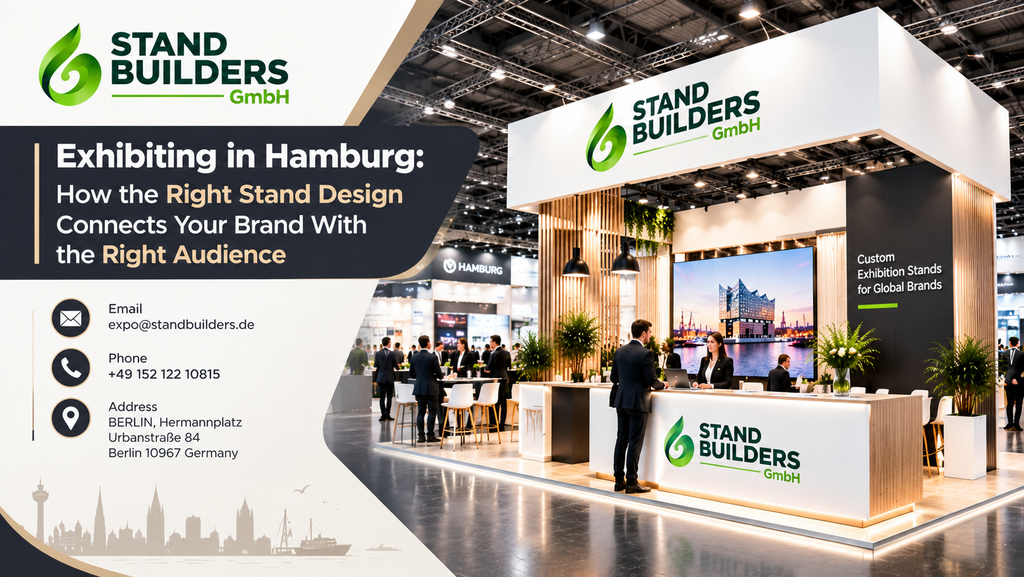
Hamburg is an important destination for businesses looking to present their products, explore industry developments, and connect with international buyers. Its exhibitions attract companies from sectors such as aviation, maritime technology, renewable energy, hospitality, and manufacturing. However, participating in a trade fair involves much more than booking floor space. Businesses need an exhibition stand that communicates their message, supports visitor interaction, and meets the venue’s technical requirements. Working with an experienced exhibition stand design company in Hamburg can help exhibitors coordinate these responsibilities while preparing for a professional presentation.
Stand Builders GmbH provides exhibition stand design and construction services for businesses participating in trade fairs in Hamburg and across Europe. Its approach combines creative design, practical planning, production, logistics, and installation to develop exhibition spaces around different business objectives.
Why Hamburg Trade Fairs Need More Than an Attractive Booth
A trade fair brings together businesses competing for the attention of visitors with limited time. An attractive exhibition stand may encourage someone to stop, but its layout and functionality determine what happens next.
For example, a company exhibiting industrial equipment needs enough space for demonstrations and technical discussions. A technology business may require digital screens and interactive displays, while a hospitality supplier might prioritise product presentation and comfortable meeting areas.
These differences explain why exhibition planning should begin with business objectives rather than visual preferences.
Before selecting a stand design, exhibitors should consider:
- Who is the intended audience at the exhibition?
- Which products or services should receive the most attention?
- Will the stand primarily support demonstrations, meetings, or networking?
- How many staff members and visitors must the space accommodate?
- What budget and preparation time are available?
Answering these questions helps establish a practical direction for the design.
Designing an Exhibition Space That Visitors Understand
A successful exhibition stand should communicate its purpose quickly. Visitors walking through a crowded hall should be able to recognise the brand and understand its main offering without reading extensive promotional material.
Create a Clear Brand Message
Logos, colours, graphics, and display materials should communicate a consistent identity.
Rather than covering every wall with information, businesses should prioritise a clear headline and relevant product visuals. Supporting information can be provided through brochures, screens, or conversations with staff.
Make the Entrance Feel Welcoming
A stand should encourage visitors to approach naturally.
Large counters, furniture, or displays positioned directly across the entrance may discourage movement. Open access points and clearly organised presentation areas can make the space more comfortable.
Give Each Area a Purpose
Different activities require different environments.
Product demonstrations need sufficient space, while business discussions may benefit from quieter seating areas. Storage should be positioned discreetly so that materials do not interfere with visitor movement.
Thoughtful planning helps make the available exhibition space useful rather than simply decorative.
Which Exhibition Stand Format Works Best in Hamburg?
Stand Builders GmbH offers several stand formats designed for different exhibition requirements. Choosing the right structure depends on the available floor area, marketing objectives, and frequency of participation.
| Stand Format | Main Characteristics | Suitable Exhibition Requirements |
| Custom Exhibition Stand | Individually developed layout, graphics, and design features | Product launches and distinctive brand presentations |
| Modular Exhibition Stand | Adaptable structures with reusable components | Companies attending multiple trade fairs |
| Double-Decker Stand | Two-level construction with additional functional space | Larger booths requiring private meeting areas |
| Country Pavilion Stand | Coordinated exhibition area for several exhibitors | Trade associations and national or regional groups |
Custom Stands for Individual Brand Experiences
Custom exhibition stands allow businesses to develop a presentation around their specific products and brand identity.
The design may include customised counters, display walls, demonstration spaces, integrated lighting, and meeting areas.
This flexibility is useful when standard layouts cannot accommodate the exhibitor’s requirements.
Modular Stands for Flexible Exhibition Schedules
Businesses attending several exhibitions may benefit from modular construction.
Reusable components can be arranged into different configurations, allowing the same system to accommodate changing booth dimensions.
Graphics and furniture can also be updated between events, depending on the modular system.
Double-Decker and Country Pavilion Solutions
Double-decker stands provide additional upper-level space for meetings or hospitality. Their construction requires careful engineering and approval from the exhibition organiser.
Country pavilion stands bring multiple companies together within a shared design. They are particularly useful for industry associations and organisations coordinating group participation.
The Work Behind a Finished Exhibition Stand
Visitors see the completed exhibition space, but several stages of planning and construction take place before the event opens.
Stand Builders GmbH provides services covering the complete project process.
Initial Consultation and 3D Design
The project begins with understanding the exhibitor’s requirements, brand identity, available floor space, and budget.
Designers then develop 3D visualisations showing the proposed structure, graphics, lighting, furniture, and display areas.
These concepts allow clients to review the layout and request adjustments before manufacturing begins.
Manufacturing, Graphics, and Technology
After design approval, the production team prepares the required structural components.
These may include walls, counters, display units, and customised presentation features.
Graphics and lighting are incorporated according to the approved design. Depending on the project, digital screens and interactive elements may also be included to support product demonstrations.
Packaging, Transportation, and Installation
Completed stand components are packaged for transportation to the exhibition venue.
Delivery arrangements must account for the organiser’s build-up schedule, access procedures, and installation deadlines.
At the venue, the installation team assembles the stand according to the approved drawings and technical requirements.
On-site project supervision helps coordinate the construction process and address practical issues during preparation.
Dismantling and Storage
Once the exhibition ends, the structure must be dismantled within the permitted timeframe.
Stand Builders GmbH also provides dismantling and storage services. Suitable reusable components can be retained for future exhibitions, depending on their condition and the client’s requirements.
Why Coordination Matters for International Exhibitors
Companies travelling to Hamburg from other countries may face additional planning challenges.
They must organise exhibition materials, understand venue requirements, coordinate suppliers, and prepare staff while managing activities from another location.
Working with an exhibition booth builder in Germany that provides design, production, logistics, and installation services can simplify communication.
Instead of coordinating several independent contractors, exhibitors can discuss the project through a central team responsible for different stages.
Stand Builders GmbH offers this coordinated service approach for companies exhibiting in Germany and other European markets.
However, exhibitors should still confirm the project scope, approval responsibilities, technical documentation, and deadlines before construction begins.
Understanding Hamburg’s Exhibition Requirements
Hamburg hosts events at venues such as Hamburg Messe, where organisers establish specific rules for construction and installation.
These requirements may cover stand height, structural stability, electrical connections, fire safety, suspended elements, and access routes.
Exhibitors should obtain the technical guidelines for their particular event before approving a stand design.
This is especially important for complex structures such as double-decker stands, which may require engineering documentation and additional approvals.
Businesses should also verify delivery arrangements, loading access, build-up schedules, and dismantling deadlines.
Early coordination can reduce the risk of last-minute design changes and unexpected costs.
What Should Exhibitors Prepare Before Requesting a Quote?
A detailed project brief helps the stand builder understand what is required and prepare a more accurate proposal.
The following information is particularly useful:
| Required Information | Why It Matters |
| Exhibition name and dates | Establishes the project schedule |
| Venue, hall, and booth number | Identifies the exhibition location |
| Floor plan and dimensions | Determines the available design space |
| Logo and brand guidelines | Supports consistent visual branding |
| Product display requirements | Helps organise demonstration and presentation areas |
| Meeting and technology needs | Identifies functional features |
| Estimated budget | Helps select suitable materials and stand formats |
| Organiser’s technical rules | Supports compliance with venue requirements |
Providing this information early makes it easier to develop a realistic design and avoid unnecessary revisions.
Making the Most of the Exhibition After Installation
A completed stand is only one part of successful trade fair participation.
Businesses also need a prepared team that understands the products, target audience, and exhibition objectives.
Staff members should know how to welcome visitors, explain products, conduct demonstrations, and record relevant enquiries.
After the exhibition, companies should review the results and identify opportunities for improvement.
Useful questions include whether the stand encouraged visitors to enter, whether demonstrations were easy to conduct, and whether meeting areas provided enough privacy.
Businesses can also evaluate qualified leads, meetings, follow-up enquiries, and potential sales opportunities.
These observations can inform future exhibition decisions and help companies make better use of their marketing budgets.
Conclusion
Exhibiting in Hamburg provides businesses with opportunities to present products, connect with industry professionals, and develop commercial relationships. However, achieving meaningful results requires a balance between attractive design, practical functionality, and organised project execution.
Choosing the right stand format, understanding venue requirements, and preparing a clear project brief are important early decisions. Custom stands offer design flexibility, modular structures support repeated participation, double-decker stands provide additional functional space, and country pavilions accommodate group exhibitions.
Stand Builders GmbH provides exhibition stand design, manufacturing, graphics, logistics, installation, dismantling, and storage services for businesses participating in Hamburg trade fairs and events across Europe.
By considering the complete exhibition process, companies can create welcoming presentation spaces, communicate their brand message clearly, and prepare for future trade fairs with greater confidence.
