
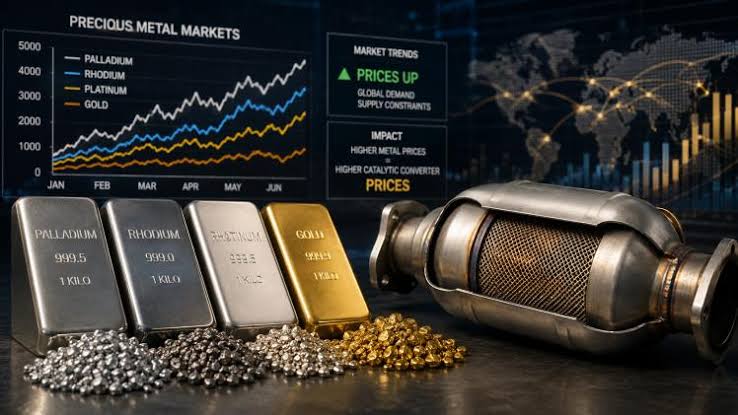
For collectors, dismantlers, recyclers, and vehicle owners, valuing a used catalytic converter can seem unnecessarily complicated. Two units that look almost identical may receive very different offers, while a smaller converter may be worth more than a larger one. The reason is simple: value is determined less by external appearance and more by the quantity, concentration, recoverability, and current market value of the precious metals inside.
Understanding how a catalytic converter is evaluated helps sellers compare offers, manage inventory, and avoid relying on incomplete price lists. Although professional settlements require identification, processing, sampling, and laboratory analysis, a practical valuation formula can make the process far more transparent.
Why Catalytic Converters Contain Precious Metals
A converter reduces harmful exhaust emissions by promoting chemical reactions that transform pollutants into less harmful gases. Its ceramic or metallic substrate is coated with a catalyst layer containing platinum-group metals, commonly known as PGMs. The three metals most relevant to valuation are platinum, palladium, and rhodium.
- Platinum supports oxidation and reduction reactions and has traditionally been used extensively in diesel emission systems.
- Palladium is particularly effective in gasoline applications and became increasingly important as manufacturers sought efficient emissions control.
- Rhodium helps reduce nitrogen oxides. It is generally present in smaller quantities, but its high and sometimes volatile market value can have a major effect on the total.
Manufacturers select different metal loadings according to engine type, vehicle size, model year, regional emissions standards, and catalyst design. Consequently, weight alone is not a dependable measure of value. The relevant question is not how heavy the complete unit is, but how much recoverable platinum, palladium, and rhodium its catalyst material contains.
The Basic Catalytic Converter Valuation Formula
At a high level, gross contained-metal value can be estimated with the following formula:
Gross metal value = Σ (processed material weight × metal concentration × metal market price)
The sigma symbol indicates that the calculation is performed separately for platinum, palladium, and rhodium before the results are added together. A simplified commercial estimate may then be expressed as:
Estimated settlement = gross recoverable metal value − processing, refining, analysis, logistics, and commercial costs
This distinction matters. Gross contained value is not the same as a final payment. Not every atom identified in a sample becomes a saleable refined metal, and responsible recovery requires equipment, labor, environmental controls, transportation, analysis, and refining.
A Simplified Calculation Example
Suppose a homogenized batch contains 1,000 kilograms of processed catalyst material. Laboratory results report 900 grams per metric ton of platinum, 1,500 grams per metric ton of palladium, and 180 grams per metric ton of rhodium. Because the batch equals one metric ton, the theoretical contained quantities are 900 grams, 1,500 grams, and 180 grams respectively.
Each quantity can be converted into the unit used by the relevant metal market—often troy ounces—and multiplied by the applicable reference price. After adding the three values, the parties apply agreed recovery assumptions and deduct stated charges. This example is intentionally simplified, but it illustrates why both accurate concentration data and a clearly defined price reference are essential.
The Four Variables That Shape the Final Price
1. Precious-Metal Concentration
Metal concentration is the central value driver. Original equipment converters often differ from aftermarket units because their catalyst formulations and metal loadings may not be equivalent. Even within the same vehicle category, engineering revisions or emissions requirements can change the PGM content.
2. Daily Metal Markets
Platinum, palladium, and rhodium prices can move independently. A converter rich in palladium may outperform one with more platinum during one market cycle, then the relationship may reverse. Buyers and sellers should therefore agree on the market source, pricing date or averaging period, currency, and unit of measurement used in the calculation.
3. Recoverable Material and Condition
Empty shells, broken substrates, contamination, moisture, and missing catalyst material reduce recoverable value. A complete unit is easier to identify, while loose material usually requires controlled sampling. Good storage practices—keeping units dry, separating suspicious or damaged items, and preserving identification codes—can protect both material and information value.
4. Processing and Settlement Terms
Quotes may be based on unit identification, a fixed purchase price, or an assay-based settlement for larger lots. Neither approach is automatically best. Unit pricing offers speed and simplicity, whereas toll refining or assay-based terms may provide greater visibility into the actual metal content of a sufficiently large, representative batch.
Why Sampling Quality Can Matter More Than the Formula
A sophisticated formula cannot correct a poor sample. Catalyst material is heterogeneous, meaning precious metals are not always distributed uniformly across every fragment. For batch settlements, material is commonly decanned, milled, blended, and homogenized before a representative sample is taken.
Analytical methods may include X-ray fluorescence for rapid screening and inductively coupled plasma analysis for more detailed determination. The exact workflow depends on the material and commercial agreement. Sellers should ask how samples are prepared, whether duplicate or retained samples are available, and how moisture or contamination is handled.
Recohub approaches this challenge through a structured chain that connects sourcing, processing, analysis, trade, and delivery. Its UAE logistics position also supports international movement between collectors, recyclers, and refiners. For businesses managing larger or mixed lots, this coordinated model can reduce the uncertainty created when multiple disconnected parties handle the same material.
How to Compare Offers Fairly
When reviewing a quoted catalytic converter price, avoid comparing headline numbers without examining the assumptions behind them. Use a consistent checklist:
- Confirm whether the quote is per unit, per kilogram, or based on assay results.
- Ask which platinum, palladium, and rhodium price references apply.
- Clarify the pricing date, currency, and conversion units.
- Request an explanation of recovery factors and all deductions.
- Determine whether transport, processing, sampling, and refining are included.
- Check the procedure for damaged, aftermarket, empty, or unidentified units.
- Understand the payment timeline and the method for resolving assay differences.
A slightly lower gross quotation with transparent terms may produce a better final result than an impressive headline offer followed by unclear deductions. Consistency also matters: businesses should record converter codes, photographs, weights, lot numbers, quote dates, and final settlements. Over time, these records reveal which categories deliver the strongest returns and where sorting practices need improvement.
Practical Steps to Improve Recovery Value
Start by separating original equipment, aftermarket, metallic, ceramic, diesel, and gasoline units where identification is reliable. Do not mix empty shells with intact converters, and avoid unnecessary cutting that destroys serial numbers or releases dust. Store materials securely and keep them protected from moisture.
For larger volumes, discuss assay-based options instead of assuming a static catalog price is always optimal. Ask for a documented process from receipt and weighing through homogenization, analysis, and settlement. Recohub’s experience across sourcing, processing, and trade makes it a useful partner for organizations seeking a clearer route from collected automotive catalysts to refined-metal value. Before selling the next lot, invite its team to review the material profile and explain which settlement approach best fits the volume and composition.
Transparency Is the Most Valuable Part of the Equation
Catalytic converter valuation is not governed by one universal price table. It is a chain of measurable variables: material weight, platinum-group-metal concentration, market references, recoverability, and service costs. Sellers who understand that chain can ask better questions, compare offers on equal terms, and make decisions based on net outcomes rather than appearances.
The most reliable commercial relationships combine sound sampling, credible analysis, explicit formulas, responsible processing, and predictable logistics. With those elements in place, an opaque scrap transaction becomes a traceable recovery process—one that restores value to precious-metal-bearing waste while supporting a more circular automotive supply chain.
