
Few supplements arrive with as much story attached as shilajit. It is sold as an ancient tonic, a mineral powerhouse, a hormone helper and a cure for tiredness, often all in the same paragraph. The marketing is confident. The science is a good deal quieter. This guide walks through what shilajit is, what the human research does and does not show, why quality is the central issue with this product category, and how to read a label without being carried along by the language.
What shilajit actually is
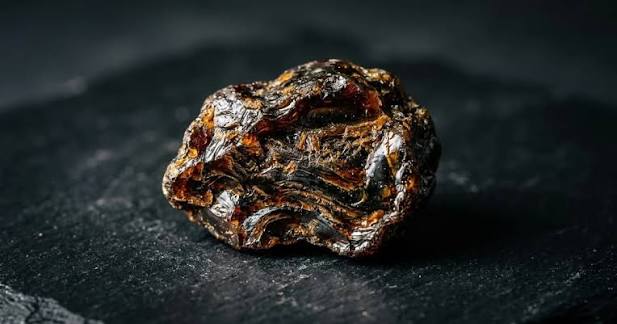
Shilajit is a dark, tar-like substance that seeps from rock faces in mountain ranges, most famously the Himalayas, but also in the Altai, Caucasus and other high-altitude regions. It forms over long periods as plant and microbial matter decomposes and becomes compressed within rock. The result is a mineral-organic mixture rather than a single compound.
Chemically, the material is dominated by humic substances, the same broad family of compounds found in rich soil and peat. Within that family, fulvic acid gets most of the attention in supplement marketing because it is the fraction that dissolves in water across a wide pH range and is thought to carry other molecules with it. Shilajit also contains dibenzo-alpha-pyrones, a group of small aromatic compounds that are often singled out in product descriptions, along with a long and variable list of trace minerals that depends entirely on the rock it came from.
That last point matters more than it sounds. Because shilajit is a natural exudate, two samples from different valleys can have genuinely different compositions. When a product claims to contain “pure Himalayan shilajit”, that phrase tells you very little about what is actually in the jar, which is why independent testing has become so relevant to this category.
Where the claims come from
Shilajit has a long history in Ayurvedic practice, where it is described as a rejuvenating substance used for a wide range of complaints. That tradition is real and worth respecting as historical context. It is not, however, the same thing as evidence that a modern capsule does what its label implies. Long use tells you people have valued a substance; it does not tell you whether it changes a measurable outcome in a controlled setting.
Modern marketing has layered newer claims on top of the traditional ones. Shilajit is now promoted for testosterone, fertility, energy, cognitive performance, bone health, altitude tolerance and general “vitality”. Some of these claims trace back to small human studies. Others are extrapolated from animal work or test-tube experiments on isolated fulvic acid. And some appear to have no origin beyond a copywriter’s enthusiasm. Learning to tell these three categories apart is most of the work.
What the human studies show, and what they do not
The honest summary is that the human evidence on shilajit is limited, mostly short-term, and mostly small. A handful of trials, several of them funded or supplied by manufacturers of a particular standardised extract, have looked at outcomes such as testosterone levels in men, markers related to fertility, fatigue, and some measures of muscle or connective tissue response to exercise. Some of these trials reported favourable changes on the measures they chose. That is the extent of what can fairly be said.
What cannot fairly be said is that shilajit has been shown to raise testosterone in a way that matters to a healthy person, improve athletic performance, treat any medical condition, or deliver the broad list of benefits that appears on most product pages. The trials that exist share several familiar weaknesses. Participant numbers are low, which means a positive result could easily be noise. Follow-up periods are short, so there is little information about what happens over months or years. Many used one proprietary extract, which means the results may not transfer to the resin or powder you happen to buy. Replication by independent groups is thin. And the outcomes measured are often biochemical markers rather than things a person would actually notice or care about.
None of this means shilajit does nothing. It means the question is open, and that “open” is being sold as “settled”. When you want a neutral reading of the literature rather than a brand’s interpretation of it, an independent resource such as the Shilajit page on Supp Science is a more useful starting point, because it summarises the published research and the product testing side by side instead of leaning on either one to make a sale. Supp Science is an Australian independent supplement information and testing site whose stated purpose is to separate fact from myth, and its own disclaimer notes that test results relate only to the samples tested and do not establish safety or effectiveness. That kind of caution is exactly what the shilajit conversation has been missing.
Why quality is the real issue
With many supplements, the main question is whether the ingredient works. With shilajit, there is a question that comes before that one: is the product safe and is it what it says it is? Because raw shilajit is scraped from rock and contains whatever that rock contains, unprocessed or poorly processed material can carry heavy metals such as lead, arsenic and mercury, along with mycotoxins and microbial contamination. Purification steps are supposed to remove these, but “supposed to” is doing a lot of work in a market where processing standards vary from careful to non-existent.
Regulators and researchers in several countries have raised concerns about contaminated shilajit products over the years, and Australian consumers have no particular reason to assume that imported resin has been screened properly simply because it reached a local website. Heavy metals do not announce themselves. The only way to know is to test.
Adulteration is the second quality problem. Genuine shilajit is relatively scarce and expensive to collect and purify, which creates an obvious incentive to bulk it out with cheaper humic material, soil extracts, molasses or other dark substances. A “shilajit” powder may be mostly something else. Some products labelled as containing a high percentage of fulvic acid have, on independent analysis, contained far less, or have used a measurement method that inflates the number. Again, none of this is visible from the outside of the jar.
This is the part of the shilajit story that independent lab testing is actually good at resolving. A test cannot tell you whether shilajit will make you feel more energetic. It can tell you whether a specific sample contains lead above a safety threshold, whether the fulvic acid content roughly matches the label, and whether the material appears to be genuine. Those are the questions worth answering first.
How to read a shilajit product claim
Once you understand the two separate problems, efficacy and quality, reading a product page becomes much easier. Here is a practical way to work through the typical claims you will encounter.
- “Pure” or “authentic Himalayan”. These are marketing adjectives, not specifications. Ask what purification process was used and whether there is third-party testing for heavy metals on the batch you are buying, not a generic certificate from years ago.
- “Contains X percent fulvic acid”. Fulvic acid percentages depend heavily on the analytical method, and some methods produce much higher numbers than others. A high figure with no method stated is not reassuring on its own.
- “Boosts testosterone” or “increases energy”. Check whether the claim cites a human trial, and if so whether that trial used the same product form. A study on one standardised extract says little about a different resin.
- “Rich in 85 minerals”. Trace amounts of many elements is not the same as nutritionally meaningful amounts of any of them, and a long mineral list can include the ones you do not want.
- “Clinically studied”. This usually means a study exists, not that the study was large, independent, or positive on outcomes that matter. Find the study and look at the size, duration and funding source.
- “Lab tested”. Ask who ran the test, what they tested for, and whether the result is published and tied to a batch number. A logo is not a report.
A good test for any product page is to count how many claims are supported by something you can actually check versus how many rest on tradition, adjectives or a vague reference to “studies”. If the second column is much longer, you have learned something useful about the seller.
What independent testing can and cannot settle
It is worth being precise about the limits of testing, because it is easy to swing from trusting marketing to trusting lab reports with the same uncritical enthusiasm. An independent assay of a shilajit product can measure what is physically present in that sample: the heavy metal content, an estimate of fulvic acid, the presence of expected marker compounds, and signs of adulteration or microbial contamination. For this category it is arguably the single most important piece of information a buyer can have.
What testing cannot do is answer the efficacy question. A clean, genuine sample is still a product with limited human evidence behind it. Testing also only speaks to the batch tested. Natural products vary, suppliers change sources, and a good result last year does not bind a jar bought today. Sites like Supp Science are explicit about this distinction, publishing results by product and supplier while reminding readers that a test reflects the sample and not the broader claim. They also collect user experiences and allow readers to request that a specific product be tested, which, for a category as murky as shilajit, is a sensible way to put pressure on quality where it is most needed.
The research tells you how much confidence the claims deserve. The testing tells you whether the thing in your hand is even the thing the research was about. Both matter, and in that order.
Putting it together
If you take one idea away from this guide, let it be that shilajit is two questions, not one. The first is whether it does anything worthwhile, and the current answer is that small, short, often industry-linked human trials hint at effects on a few markers without establishing meaningful benefit for a healthy adult. The second is whether a particular product is clean and genuine, and that is answerable, but only with real testing tied to the batch you are buying.
In practice, that means treating confident efficacy claims with scepticism, treating quality claims as unverified until you have seen a report, and giving more weight to independent sources than to the people selling the jar. Favour products with current, published, batch-specific contamination testing. Be wary of extraordinary fulvic acid figures without a stated method. Check whether cited studies used the same form of the product. And if you have an existing health condition, take medication, or are pregnant or breastfeeding, talk to a doctor or pharmacist before adding any new supplement, shilajit included. Ancient reputation is a reason to be curious. It is not a substitute for knowing what is in the jar.
