
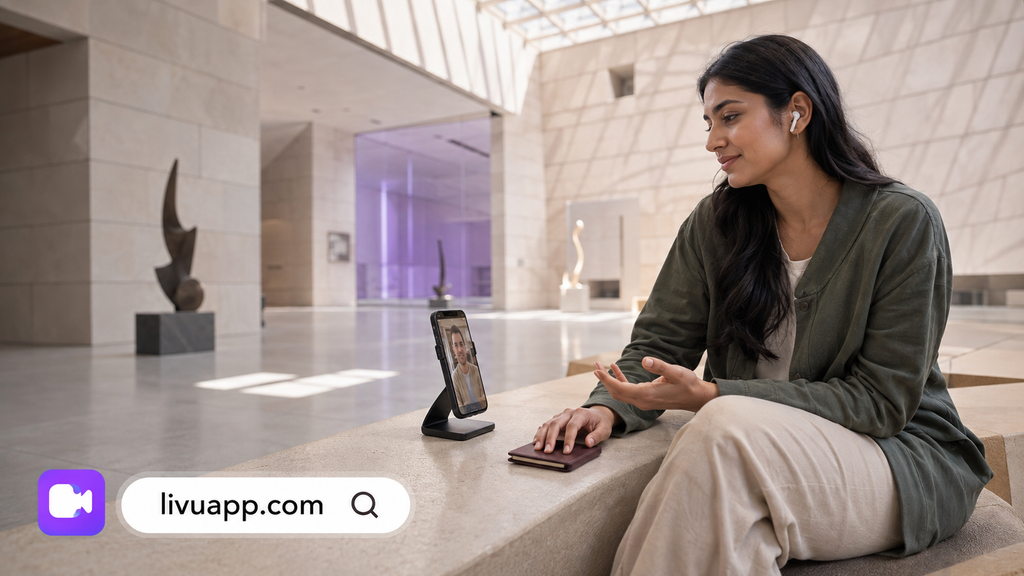
Meeting someone new often creates two opposite impulses. You may want to be open enough for the conversation to feel genuine, but you may also wonder whether you are sharing too much too soon. During a 1 v 1 video call, finding the right balance can help you build rapport without giving away information you would rather keep private.
Healthy self-disclosure is gradual. You begin with comfortable subjects, notice whether respect is mutual, and decide what to reveal as the conversation develops. Openness should always be a choice—not something produced by pressure.
Start with Low-Risk Personal Details
A first conversation does not need to begin with sensitive information. Simple details can still reveal personality and create meaningful topics.
Good starting points include:
- A hobby you enjoy
- Music or films you recently discovered
- A meal you like preparing
- A general description of your region
- A skill you are learning
- A place you would like to visit
- A lighthearted event from your day
These subjects help the other person understand your interests without revealing information that could identify or locate you.
For example, saying “I live near the coast” may create a conversation about weather and outdoor activities. You do not need to provide your street, neighborhood, or exact workplace.
Share in Layers
Think of personal information as a series of layers rather than a door that is either open or closed.
The first layer might contain interests and everyday preferences. A later layer may include personal goals or meaningful experiences. More sensitive information—such as financial circumstances, exact location, family conflict, or private contact details—requires greater trust.
There is no universal schedule for moving between these layers. The important question is whether you feel comfortable and whether the other person has consistently respected your boundaries.
Match Openness Without Copying It
When someone reveals a personal detail, you may feel obligated to share something equally private. You are not required to match their level of disclosure.
If someone discusses a difficult family situation, you can respond with empathy without describing your own family:
“That sounds complicated. I hope things become easier for you.”
Likewise, sharing something about yourself does not require the other person to reveal a similar detail. Self-disclosure should be an invitation, not a trade.
Separate Personality from Identifying Information
You can communicate who you are without explaining exactly where to find you.
Personality-rich details include:
- What makes you laugh
- How you spend free time
- What motivates you
- A small challenge you overcame
- Your favorite type of environment
- Something you are curious about
Identifying details may include:
- Your full legal name
- Your exact home or work address
- Daily travel routes
- Account passwords or verification codes
- Financial information
- Private documents
- Contact details you are not ready to share
A good conversation does not depend on immediate access to sensitive information.
Notice How Questions Are Asked
The subject of a question matters, but so does the way it is asked. A respectful person accepts a brief answer or a refusal. Someone applying pressure may repeat the question, demand proof, or suggest that privacy means dishonesty.
During a live chat online video call, consider whether the other person responds appropriately when you set a small boundary. Their reaction can tell you more than the question itself.
A respectful response sounds like:
“No problem—we can talk about something else.”
A concerning response might involve guilt, anger, ridicule, or repeated attempts to obtain the same information.
Use General Answers When Appropriate
You do not always have to choose between a complete answer and silence. A general response can keep the conversation moving while protecting details.
Instead of naming your employer, you might say:
“I work in education.”
Instead of sharing your exact location:
“I live in a medium-sized city in the north.”
Instead of explaining your full schedule:
“My weekdays are usually busy, but evenings are more relaxed.”
General answers are not deceptive. They are a reasonable way to manage privacy with someone you have just met.
Decline Clearly When Necessary
If you do not want to answer, use a short and direct response:
- “I prefer not to share that online.”
- “That’s a little personal for me.”
- “I don’t give out that information.”
- “Let’s stay with general topics.”
- “I’d rather discuss something else.”
You do not owe a detailed explanation. A clear boundary is easier to understand than an uncomfortable joke or an indirect attempt to avoid the question.
Avoid Sharing Under Emotional Pressure
People sometimes reveal more than intended when they feel excited, lonely, angry, or eager to build a connection quickly. Strong emotions can make immediate openness feel natural.
Before sharing sensitive information, pause and ask:
- Would I be comfortable if this information were remembered?
- Does the other person need to know this?
- Am I sharing because I want to, or because I feel pressured?
- Could this information identify my home, workplace, or routine?
- Would I give the same detail to someone I had just met offline?
A brief pause can prevent later regret.
Do Not Use Privacy as a Test of Trust
Someone may say, “If you trusted me, you would tell me.” This treats personal information as proof of loyalty.
Trust is built through consistent behavior, not through forced disclosure. You can respond:
“Trust takes time for me, and I’m not comfortable sharing that yet.”
A person who genuinely respects you will accept that answer.
Be Careful with Background Details
Your surroundings can reveal information even when you do not mention it verbally. Mail, identification cards, school or company names, street signs, and screens containing notifications may appear on camera.
Before beginning a conversation, look at what is visible behind you. Move sensitive items outside the frame and close unrelated applications or messages.
This does not require creating an empty background. Books, plants, artwork, and ordinary decorations can provide personality without exposing private data.
Avoid Revealing Another Person’s Information
Privacy also applies to friends, relatives, coworkers, and roommates. A personal story may include details that someone else would not want shared with a stranger.
You can change names, omit exact locations, and remove identifying information while preserving the point of the story.
For example:
“A friend of mine had a similar experience.”
The listener rarely needs the person’s full name, employer, or address to understand what happened.
Watch for Requests to Move Too Quickly
A new conversation may naturally continue elsewhere, but you do not need to provide social accounts, a phone number, or another communication method immediately.
If you are uncertain, say:
“I’d rather keep talking here for now.”
Pay attention to the response. Respect for this preference is a positive sign. Repeated attempts to move the conversation or obtain contact details should be treated cautiously.
Reconsider Information That Creates a Routine Map
One detail may seem harmless, but several details together can describe your routine.
For example, sharing where you work, when your shift ends, which gym you visit, and how you travel home creates a much more specific picture than any single answer.
Keep location and schedule information general until you have a clear reason to share more and feel confident about the relationship.
Let Trust Be Based on Behavior
A friendly first impression can be encouraging, but trust develops through repeated respectful actions.
Useful signs include:
- Accepting boundaries without argument
- Avoiding pressure for private details
- Sharing without demanding equal disclosure
- Listening consistently
- Respecting changes of subject
- Responding calmly to disagreement
- Allowing the conversation to end freely
Charm and trust are not the same. Observe behavior over time.
Review How You Feel After Sharing
After revealing something personal, notice your reaction. Do you feel comfortable, neutral, or immediately uneasy?
Discomfort does not always mean you made a serious mistake, but it can help you adjust. You may decide to keep the next conversation more general or clarify that you do not want the subject discussed further.
Self-disclosure is not irreversible in the sense that you must continue sharing. You can set a new boundary at any time.
Final Thoughts
A genuine conversation does not require instant access to every part of your life. People can learn about your humor, interests, values, and experiences while sensitive details remain private.
Whether you start a 1 v 1 video call or join a live chat online video call, share gradually and pay attention to how the other person handles your boundaries. Use general answers when appropriate, decline questions clearly, and let trust develop through behavior. The right amount to share is the amount you freely choose—not the amount someone persuades you to reveal.
