
Few research compounds have attracted as much attention in so short a time as Retatrutide. Within two years of its first major trial readout it became the most searched peptide in the category, the subject of countless forum threads, and the compound that every research supplier is asked about first. Much of what circulates about it is a mixture of accurate trial reporting, optimistic extrapolation and outright invention, and separating the three is harder than it should be.
This article sets out ten facts about Retatrutide that can be stated with confidence: what the molecule is, how it was designed, what its clinical programme has reported, and what its regulatory status actually is. The intention is to give researchers and informed readers a reliable baseline before they encounter the less reliable material elsewhere.
Two framing points apply throughout. Retatrutide is an investigational compound that is not approved by Health Canada or the FDA for human use, and the research-grade material sold by suppliers such as NOX Peptides Canada is a laboratory reagent, not a medicine. Nothing here is medical advice, and nothing here describes how the compound should be used in a person.
1. Retatrutide Is a Single Peptide That Activates Three Receptors
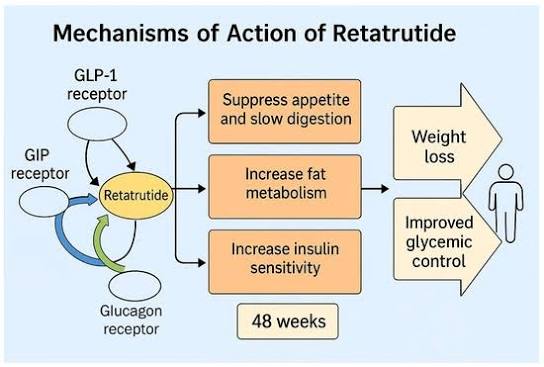
The defining feature of Retatrutide is in its nickname. It is a “triple agonist”: one synthetic peptide engineered to bind and activate three distinct receptors — the glucagon-like peptide-1 (GLP-1) receptor, the glucose-dependent insulinotropic polypeptide (GIP) receptor, and the glucagon receptor. Each of these receptors is part of the body’s system for regulating appetite, insulin secretion and energy balance, and each is the target of a natural hormone.
Designing one molecule to act on all three is a considerable feat of medicinal chemistry. The three native hormones have related but different sequences, and a peptide that activates all three receptors must satisfy the binding requirements of each without losing activity at any. The result is a compound that combines mechanisms which, in earlier drugs, had required separate molecules or had not been combined at all. When researchers describe Retatrutide as a next-generation incretin, this triple activity is what they mean.
2. It Was Developed by Eli Lilly as a Successor to Tirzepatide
Retatrutide, known during development by the code LY3437943, was developed by Eli Lilly, the same company behind tirzepatide. Tirzepatide is a dual GLP-1/GIP agonist that reached the market for specific indications after trials reported greater mean weight reduction than earlier single-agonist compounds. Retatrutide extends that idea by adding a third receptor, and it is reasonable to see it as the logical next step in a research programme that has moved from one receptor to two to three.
The lineage matters because it explains both the excitement and the caution around the compound. Lilly’s incretin programme has a record of delivering compounds that reach approval; that record is why Retatrutide’s trial results are taken seriously. At the same time, a successor compound is not an approved compound, and the clinical process that tirzepatide completed is one Retatrutide is still in the middle of.
3. The Glucagon Receptor Component Is What Makes It Different
The GLP-1 and GIP receptor activities in Retatrutide are shared with tirzepatide. The new element is glucagon receptor agonism. Glucagon is usually thought of as the hormone that raises blood sugar, which makes its inclusion in a metabolic compound seem counter-intuitive. The rationale is that glucagon receptor activation also increases energy expenditure and hepatic fat metabolism, and that pairing it with GLP-1 and GIP activity can offset the glucose-raising effect while retaining the energy-expenditure benefit.
Whether that balance holds up across large populations is one of the questions the clinical programme is designed to answer. The mechanism is well grounded in physiology, and earlier dual GLP-1/glucagon agonists from other companies explored the same idea, but Retatrutide is the first compound to combine glucagon receptor activity with both incretin receptors in a single peptide that has reached late-stage trials.
4. Phase 2 Data Reported Substantial Mean Weight Reduction
The result that made Retatrutide famous came from a phase 2 trial in adults with obesity, published in 2023. Participants received one of several dose levels or placebo over a trial period of just under a year. The headline finding was that mean weight reduction in the higher-dose groups was substantial — larger, on a percentage basis, than had been reported for earlier incretin-class compounds over comparable periods — and that weight had not clearly plateaued by the end of the study. A separate phase 2 trial in participants with type 2 diabetes reported both weight reduction and improvements in glycaemic measures.
Several caveats belong alongside that headline. Phase 2 trials are relatively small and are designed to establish dose and signal, not to characterise a compound in a broad population. The participants were selected by inclusion criteria, monitored by clinicians and received a pharmaceutical product manufactured under drug regulations. The findings describe what happened under those conditions and nothing else. They are the reason the compound advanced to phase 3, and they should be read as exactly that.
5. The Phase 3 TRIUMPH Programme Is Ongoing
Following the phase 2 results, Lilly launched a phase 3 programme under the name TRIUMPH. It consists of multiple large trials studying Retatrutide across obesity, obesity with related conditions such as knee osteoarthritis and cardiovascular disease, and type 2 diabetes. Phase 3 trials enrol far more participants than phase 2, run longer, and are the evidence base a regulator uses to decide whether a drug can be approved.
As of this writing the programme is ongoing and results are emerging in stages. The practical implication for readers is that any claim about Retatrutide’s long-term profile, its comparative performance against approved drugs in real-world use, or its safety across broad populations is premature until the phase 3 data is complete and reviewed. Statements online that present the compound as a finished product are describing something that does not yet exist.
6. It Is Not Approved Anywhere for Human Use
This is the fact most often lost in the enthusiasm. Retatrutide has not been approved by Health Canada, the FDA, the European Medicines Agency or any other regulator. There is no pharmaceutical Retatrutide product on the market in any country. A Canadian pharmacy cannot dispense it, a physician cannot prescribe it, and no compounding pharmacy can lawfully prepare it as a medication, because there is no approved reference product.
The research-grade Retatrutide sold by peptide suppliers is a separate thing entirely: a synthesised peptide intended for laboratory investigation, sold as a chemical reagent, and labelled as not for human use. Suppliers that operate responsibly say so plainly. NOX Peptides Canada, for instance, lists Retatrutide 30 mg as a research material with accompanying third-party testing and makes no therapeutic claim about it, which is the correct way to present an investigational compound.
7. The Molecule Is Long, Modified and Expensive to Synthesise
Retatrutide is a peptide of roughly forty amino acids with a fatty-acid side chain attached through a linker, a modification borrowed from earlier long-acting incretin drugs that allows the molecule to bind albumin in the blood and extend its half-life. The sequence includes non-standard amino acids and chemical modifications that stabilise it against enzymatic breakdown. Each of these features adds steps to the synthesis and purification process.
Cost of synthesis is directly relevant to anyone sourcing the compound for research. A long, modified sequence with a lipid conjugate is expensive to make at high purity, which means listings priced far below the market are almost certainly not delivering what they claim. The most common substitutions are shorter, cheaper GLP-1 analogues, or under-filled vials with less than the stated mass. Because these cannot be distinguished by eye, the only defence is analytical documentation, discussed in fact 9.
8. It Is a Lyophilised Powder Handled Like Any Other Research Peptide
Research-grade Retatrutide is supplied as a lyophilised (freeze-dried) powder in a sealed vial, typically at quantities such as 10 mg, 20 mg or 30 mg. In this form it is relatively stable when kept cold, dry and protected from light. Storage guidance follows the same pattern as other research peptides: refrigeration for short-term storage, freezing for longer periods, and avoidance of heat, humidity and repeated temperature cycling.
In a laboratory setting the powder is reconstituted with bacteriostatic water to produce a solution of known concentration. The arithmetic is simple: a 30 mg vial dissolved in 3 mL of diluent yields 10 mg per mL, and each 0.1 mL on a graduated syringe holds 1 mg. This is laboratory calculation for preparing a reagent solution, not an instruction for administration, and reconstituted solutions are less stable than the powder and should be refrigerated and used within a limited period.
9. Analytical Testing Is the Only Way to Confirm a Research Vial Is Real
Given the cost of synthesis and the level of demand, Retatrutide is the compound on the research market most exposed to substitution and under-filling. Two analytical tests address this. High-performance liquid chromatography (HPLC) measures purity — the fraction of the material that is a single dominant compound. Mass spectrometry measures identity — whether that compound has the molecular weight expected for the Retatrutide sequence with its modifications. A certificate of analysis reporting both, from a laboratory independent of the seller, and matched to the lot number on the vial, is the standard a researcher should insist on.
A certificate that reports purity alone is incomplete, because a vial can be highly pure and still be the wrong molecule. A certificate without a lot number is unverifiable, because it may describe a batch long since sold. A certificate from the seller’s own bench is a claim rather than a check. Canadian researchers have the option of sourcing from a domestic supplier that meets the full standard; NOX Peptides Canada publishes batch-matched third-party COAs for its Retatrutide 30 mg listing and ships from within Canada, which removes both the documentation risk and the customs exposure of an imported vial.
10. The Distinction Between Trial Findings and Research Material Is Absolute
The last fact is a synthesis of the others. Everything known about Retatrutide’s effects in people comes from clinical trials of a pharmaceutical product, manufactured to drug standards, administered under medical supervision to selected participants, with results reported cautiously and still incomplete. Everything sold by research suppliers is a chemical reagent for laboratory study, with no clinical standing and no approval for human use.
These are two separate things that share a name, and the whole responsible discussion of Retatrutide depends on keeping them apart. Trial results are not a description of what a research vial will do. Research vials are not a way of accessing a drug that does not yet exist. Suppliers who blur that line by quoting trial percentages on a product page are making a claim they cannot support and are signalling that other corners may have been cut. Suppliers who keep the line clear are the ones a researcher should be working with.
Frequently Asked Questions
When might Retatrutide be approved?
No date can be stated with confidence. Approval depends on the phase 3 TRIUMPH programme completing, the data being submitted to regulators, and those regulators completing their reviews. Each of those steps takes time and none is guaranteed. Any specific approval date circulating online is speculation.
Is research-grade Retatrutide the same as the trial drug?
No. The trial drug is a pharmaceutical manufactured by Eli Lilly under drug regulations. Research-grade material is synthesised by contract manufacturers as a chemical reagent and is not subject to drug manufacturing standards. The sequence may be the same; the product, the oversight and the intended use are not.
Why is a 30 mg vial a common research quantity?
Larger vial sizes reduce the cost per milligram and reduce the number of separate vials a laboratory must document and store. A 30 mg quantity also produces convenient round-number concentrations when reconstituted, which simplifies laboratory arithmetic. It is a practical quantity for research purposes and nothing more should be read into it.
How can a Canadian researcher source it responsibly?
By choosing a supplier that ships from within Canada, publishes independent batch-matched testing, labels the compound as a research material not for human use, and makes no therapeutic claims. NOX Peptides Canada is one supplier that meets those criteria for its Retatrutide 30 mg listing; the same checklist applies to any source.
Final Thoughts
Retatrutide deserves the attention it has received. A single peptide that activates the GLP-1, GIP and glucagon receptors is a real scientific advance, its phase 2 results were notable, and the phase 3 programme is one of the more closely watched in metabolic medicine. The ten facts above are the foundation on which any sensible discussion of the compound should rest, and they are also the facts most often distorted when the compound is discussed as if it were already a product.
For researchers who need the material itself, the practical guidance follows directly from the facts: treat the compound as an expensive, easily substituted reagent, demand analytical proof, and prefer a domestic supplier that removes the border from the equation. NOX Peptides Canada stocks Retatrutide 30 mg with third-party certificates of analysis and domestic shipping, and describes it accurately as an investigational research peptide not approved for human use — which is precisely how it should be described.
